Wednesday, May 22, 2013

Deus ex Glorfindel


While we don't have an Elven princess rolling in on a white horse to save the day, we have an immensely powerful Elf-lord from the 1st Age who finds the party and guides them back towards Rivendell. Similar concept, but more believable in Tolkien's words, I feel. I mean, the Nine are pretty much the most badass things outside of Sauron and Saruman in terms of wicked things (not counting Durin's Bane), but yet Elrond sends his daughter - and only child - to find Aragorn and the Hobbits?

Come on.

Anyway, I'm over that because Glorfindel is just too cool.

Glorfindel is a character who also appears in the Silmarillion where he is a lord of Gondolin, the last great Elven kingdom in the First Age, and the site of one of the Silmarillion's most famous scenes. The Fall of Gondolin is the story of how Morgoth found the location of the last Elven kingdom that defied him and sent his hordes of dragons, balrogs, and orcs to take it. The Fall of Gondolin is also the earliest story that Tolkien wrote. The earliest part is from 1916, when he wrote while in the trenches of World War 1. This is a full forty years before LOTR is published. Crazy.

Glorfindel was a powerful lord of the city and fought fiercely, including 1-1 combat with dragons to buy time for his House to escape. It was during this battle that Ecthelion, Captain of the Gondolin Guard, faced the chief of the Balrogs - Gothmog - in single combat AND WON!

But while Ecthelion is being a mad boss, he also died during the fight and won on the technicality that he just pushed Gothmog into the central fountain which extinguished his flame, killing Gothmog. Technicality.

Glorfindel and the Balrog by Ted Nasmith


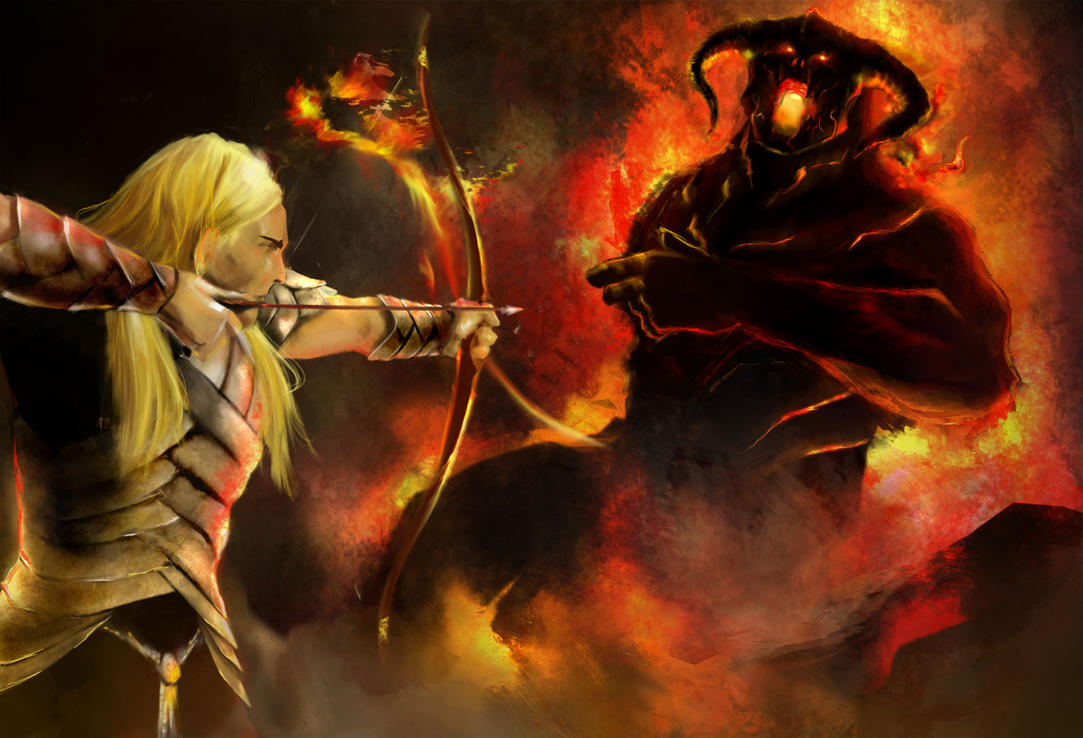
Glorfindel is continuing to leading the people of the city out through secret ways and they are ambushed by an army of orcs lead by another Balrog! This time, Glorfindel faces him 1-1 and after a long and tiring combat, defeated the Balrog fairly and decisively. As the Balrog fell from the mountain, he reached up and grabbed Glorfindel, pulling him to his death. 

This action allowed the human hero Tuor to survive. Tuor is the most famous man of the First Age (outside of his cousin Turin) and is the only human to ever earn the honor of sailing to Valinor and becoming immortal. What a boss.

Glorfindel and the Balrog by HectorBetancur


Because of Glorfindel's bravery and pure dedication to saving his people, his spirit was revived by Manwe so he could live again. LITERALLY, DEATH CANNOT BEAT THIS DUDE.

So Glorfindel spends the next several hundred years in Valinor where he is now nearly as powerful as the Maiar (Gandalf, Saruman, Sauron, etc). He spends a lot of time with Olorin (Gandalf's name before he came across the sea) and they became good friends. Sometime around the forging of the Ring, Glorfindel returns to Middle-Earth to aid Gil Galad and Elrond in their fight against Sauron.

So this bad-ass is the one that Elrond sends to find Frodo.

I'm a huge fan of Glorfindel and he is one of my favorite characters in the entire legendarium.

Tuesday, May 21, 2013

Book 1 Chapter 12: Flight to the Ford

Flight to the Ford is a cat and mouse game through the Trollshaws, a lawless and rugged land west of Rivendell. This 17 day adventure from the night of Frodo's stabbing to his healing at Rivendell is condensed into 5 minutes and a wonderful Deus ex Arwen to save the day.

Granted, a powerful elf on a white horse does appear out of nowhere and saves the day, but I think it makes a little more sense than freakin' Arwen.

Anyway, the chapter starts right after Frodo is stabbed. I think it's important to note just how many times Frodo is stabbed during his quest. Here on Weathertop, nearly skewered in Moria, and impaled by Shelob in Cirith Ungol. There is probably a joke about Sam in here too but I'll leave that alone.

In any case, the Riders stab Frodo and then are immediately chased off by Aragorn by which we can assume that they are aware who he is and fear/respect his power. Why would they flee from one man with the Ring so close? 

I think the answer is a mix of respect for Aragorn and that it simply is not their nature. In a previous chapter, Aragorn discusses that the Riders would not barge into the Prancing Pony because they were not at full strength (all 9), and they preferred to avoid direct fighting. Only 5 of the Riders were present at Weathertop so we can assume they fell back with the hope that the wound would overcome Frodo and he would become their servant (the fate Gandalf hints was in store for him during the next chapter).

Hands of the King


So Frodo isn't immediately rescued by a white pony and a Liv Tyler, but is instead kept alive by the hands of Aragorn.

In Return of the King, Faramir notes that the hands of the king are hands of a healer. This is in contrast with the view that great warriors make a king and is Tolkien's way of affirming what he believes is the most important characteristic in a ruler. Aragorn's hands of healing are physically manifested in literal healing powers instead of metaphoric power, but this situation is one of the earliest examples.

Aragorn keeps Frodo alive and they dodge, duck, dip, dive, and dodge their way through the woods, avoiding trails and taking the rough route through the land.

Merry 

We've discussed this before, but Merry really steps up his game in this chapter. While the quest revolves around Frodo and there is deference to his thoughts, Merry is really the dominant Hobbit voice in the party. After about 10 days in the wilderness, Frodo collapses on a climb and Merry is the one to stand up to Aragorn about needing to stop and rest. He is in tune with Frodo more than most and speaks to Aragorn as almost equals. 

Similarly, the next morning it is Aragorn and Merry who journey out and survey the land for a better route. The other Hobbits are not even considered and, although Tolkien doesn't write it, it's probably an obvious choice within the party. Merry has been a leader the entire time so far and it would be natural that he picks up the slack and assumes a leadership mantle.

A Song in the Trollshaws by Ted Nasmith

Sam the Bard

Sam is a Hobbit of many talents. When the party comes across the Trolls that nearly made a snack of Thorin's 12 dwarves and Bilbo in The Hobbit, Sam sings a song while they relax.

When he finishes, others applaud and ask where he heard it or who taught him the tune. Sam is sheepish and Frodo senses the truth.

"I am learning a lot about Sam Gamgee on this journey.  First he was a conspirator now he's a jester.  He'll end up by becoming a wizard - or a warrior! " 

Seems awfully prescient...

Even better is Sam's response.

" I hope not.  I don't want to be neither"
Sam doesn't dream of gathering power unto himself. He is far too selfless for that. His heart is set elsewhere and this pure heart and strength of character is what makes him a model guardian for Frodo on this quest.

Really like this exchange.

Conclusion

After the Trolls, the chapter begins wrapping up but does so with the introduction of one of the biggest bad-asses in Middle-Earth. I will talk more about Glorfindel and his badassery tomorrow morning in a post!

Tuesday, May 7, 2013

Morgoth and the 1st Age

After Brandon's comment on my "Knife in the Dark" post, I realized that I've neglected to provide any background on an important, if rarely mentioned character - Melkor, the original big bad guy whom the Elves call Morgoth or "Black Foe".

First thing to understand is that the Valar are divided into two "castes" for lack of a better word. At the beginning of time, the Ainur (the "higher" ranked caste) joined with Eru (the one God) to sing the world into creation. Melkor was the greatest among the Ainur and Eru's most trusted servant. While the other Ainur had individual realms that they ruled (for example: Ulmo - the sea, Orome - wildnerness, the hunt) Melkor held sway in each of these areas. So he was pretty damn powerful.

One of the big themes in the Silmarillion is the idea of the "creator". Tolkien's personal beliefs made him uncomfortable creating a polytheistic world and so he made a singular deity (Eru) above the "pantheon" he had already created. One of the outcomes of this was that only Eru has the power to create, which he does by creating the Elves and Men in Middle-Earth.

We can contrast with the story of the Dwarves. Aule, the Smith of the Valar, labored under the mountains of Middle-Earth and created the seven Dwarf fathers but he could not give them life - only Eru has that power. When Eru discovered, Aule offered to destroy them since he did not have the ability or permission to create, but Eru stayed his hand and gave the Dwarves life, but they could only awake after the Men and Elves did.

Now, Melkor was not humble about this ability like Aule was. He was a bit jealous of the ability to create and wanted to create his own ideas.

During the initial song of creation, Eru gave each Valar the notes that they needed to sing in order to create the world. Melkor decided to edit his parts and create something original. This change did not fit in with Eru's plan, and Melkor's new notes created discord in the song which is what Tolkien used to explain how bad things entered the world. The discord in the song created strife, pain, and suffering.

Morgoth by Ted Nasmith


Cast Out of the Valar

His strength of song was praised by Eru but he was admonished for being selfish and everafter, Melkor resented the other Valar and actively waged war against them.

When the Elves first awoke, Melkor was the first to encounter them and swayed many to his side, corrupting them into the Orcs. This is an important distinction because he did not CREATE the Orcs, only corrupted what already existed.

With the Orcs, evil men, as well as many other terrible and fell servents - spirits of the world manifested like Glaurung the father of all Dragons, or corrupted Maiar (which are the lower "caste" of the Valar) like Sauron - Melkor waged war against the Valar and caused much strife.

The Valar eventually assaulted Utumno, Melkor's fortress, and captured him. Chained in unbreakable chains, he was imprisoned in Mandos (purgatory) for a long, long time. After this, he pretended to be repentant and the Valar bought it because they didn't understand evil or the depth of Melkor's fall. 

He began to spread lies quietly among the Elves, sowing anger and dissent against the other Valar. The most vocal of these Elves was Feanor, a powerful lord and the greatest Elvish craftsmen to ever live. Feanor was brought before Manwe (think Zeus) for judgement and Melkor's lies were discovered leading to another massive manhunt for him. But Melkor evaded them and continued to seek the Silmarils - legendary, perfect jewels crafted by Feanor which not even Aule, the Smith "God" could make.

This hunt for the Silmarils and the ensuing back and forth conflict is known as the Silmarillion...

The Fall

Anyway, I want to save most of the Silmarillion for another time because there is just too many great stories. Beren and Luthien takes place here, as does the story of Turin Turambar, the greatest warrior who ever lived. And as mentioned before, Feanor is a fantastic character. He is Tolkien's Elvish equivalent to Original Sin and his story arc is very distinct from most Elves we encounter. We can have separate posts for each.

But Melkor is renamed Morgoth by Feanor meaning "Black Foe" and this is how he is known by later generations. Eventually, the Host of Valinor, led by brave lords of men and Elves and with the Valar joining as well. They capture Morgoth, bind him again, and this time cast him out into the "Void", the netherworld between worlds where he cannot escape.

His legacy lives on through Sauron who was his top lieutenant and inherited control over the fell creatures and the Orcs. The prophecy states that Morgoth will eventually escape his chains and return to the world causing the Dagor Dagorath or the apocalypse. At this time, Manwe (Zeus) will unleash all of the dead spirits and the full might of the Valar against the renewed hosts of Morgoth.

Hope this was useful in explaining more about the Great Enemy that is occasionally referenced in the Lord of the Rings but never explained!

Monday, May 6, 2013

Chapter 11: A Knife in the Dark

This chapter is a long one and covers quite a bit of ground. For simplicity's sake, I've divided the chapter into 3 sections.

Fire on Weathertop by Ted Nasmith

The Riders in Buckland

The first part of the chapter brings us back to Crickhollow and Fatty Bolger, who is still pretending that Frodo is holed up there to aid the Hobbits' flight through the Old Forest. However, this is the night that the Riders make themselves known and raid Frodo's house.

Silence descends on the house which must be strange considering how close it is to the Old Forest and it's many bugs and other noisy critters. Three shadowy figures enter the yard of Frodo's house and approach the door. As you can imagine, Fatty has bolted out the back door and is high-stepping it away as fast as his legs can carry him but the Riders don't know that.

They pound on the door, demanding that they open the door in the name of Mordor. A brave soul, indeed, is needed to refuse that.

Fatty has reached neighbors and began spreading the alarm. Word reaches Brandy Hall where the Master of Buckland (Merry's father) blows the Horn of Buckland to muster the Brandybucks and the other hobbits into a militia to repel the Riders. 

Can you imagine this? Put yourself in the position of the residents of Buckland. 

You've lived your entire life without hearing this horn, and most of your parents have never heard it either. Suddenly, in the middle of the night, a sound like rolling thunder blares over the hills, waking you and demanding your attention. Then, you are expected to heed the Master's call and appear, with pitchforks, clubs, whatever you might have, to repel the threat facing the land.

It's just a cool scene. Go re-read the beginning of this chapter.

Journey through the Marsh

The second part is more character development and historical fluff, detailing the departure from Bree and the slow slog through the Midgewater Marshes that separate Breeland from the barren lands guarded by Weathertop.

Frodo wakes the morning of their departure with a dream of hearing the Horn of Buckland. How does Frodo keep having these prophetic dreams? Tolkien has eschewed much outright magic, especially among those not of the older, nobler blood of the Elves (which includes the Numenorean men like Aragorn). Hobbits, Dwarves, and most men we encounter have no such proclivity.

Could these dreams be related to the Ring? My current favorite theory is that the Ring is acting a bit like a walkie-talkie here. Sauron is aware of who has the Ring but doesn't really know how to behave with someone else in possession of it (Isildur died and then it mostly disappeared. Gollum kept it in a pile and not always wearing it. Plus, it drove him mad). My theory is that these dreams are little bits of Sauron's experiences peeking their way into Frodo's head through the Ring. His dream here is about the Riders, who most certainly are intimately connected with Sauron and also fled from the Horn. Previously, he dreamed of Gandalf's escape from Isengard, which Sauron likely observed through the Palantir located there.

It's not a perfect theory, but I think its more plausible than Frodo somehow being a "seer" or something. Your thoughts?

Anyway, the party leaves Bree and they hit the road. Strider again speaks highly of his skills, boasting that he never takes the wrong path. Besides coming as a dismissal to Sam, it's important to remember that in the books, Aragorn is the one who argues against going to Moria the most. Gandalf convinces the others, however, and he reluctantly goes along. Turned out that Strider, indeed, never takes the wrong path. Willingly, at least.

They slog their way through the marsh and reach the barren, empty lands leading up to Weathertop. Frodo makes a crack while walking about losing so much weight, joking that soon, "I shall become a wraith". Strider is not amused by the joke, and this line is fairly prophetic to what happens at the end of the chapter when he is stabbed by a morgul blade and is in danger of becoming, you guessed it, a wraith.

I just noticed this line on the current read-through. Good stuff.

Storytelling and Conflict at Weathertop

The last portion of this chapter is dominated by two large history dumps, one about Gil-Galad, the last Elven High King, and the other about Beren and Luthien.

As they approach Weathertop, Strider explains this was once a great watchtower of the Northern kingdom and was where Elendil (Isildur's father) waited with his host for Gil-Galad and the Elven armies to join him on the march south to Mordor. Just when he is about to explain more about Gil-Galad, Sam bursts into song and sings a lovely ballad about the king.

Sam! As if we needed more reasons to like him, he sheepishly explains that he learned the song from Mr. Bilbo and memorized it years ago. Sam, our Elven scholar. Strider is also pretty impressed by Sam's knowledge of this ancient song and also impressed by Bilbo for having translated it. Bilbo must've been pretty busy the past 50 years translating all bits and pieces of Elvish history he could find. 

Also telling because it shows that Strider knows Bilbo. Not surprising, really, but shows that Bilbo wasn't the "hermit" many of the hobbits believed him to be.

Secondly, while the party waits in the night for the Riders to appear, Strider sings them the ballad of Beren and Luthien. This is an abbreviated story that is told in much greater detail in the Silmarillion and is one of the deepest and most tragically beautiful stories Tolkien told. 

I've written about it a bit previously, but Luthien was an elf (half-deity really, her mother was akin to Gandalf) and Beren was a lord of men. He fell in love with her and begged her father, King Thingol for her hand. He refused and set upon Beren an impossible task: retrieve a Silmaril from Morgoth (Sauron's boss). Beren, like a boss, puts his man-pants on and marches into Angband, and steals away a Silmaril from Morgoth's crown. It's kind of like the 12 Labors of Hercules if you are familiar with that story.

Anyway, then Strider goes on and on about their sons and daughters, stating the Elrond is a grandson of theirs and all the Kings of Numenor are descendents as well. Which, lets us know that Strider is of their blood and that story is especially touching since he is also in love with an elf whose father disapproved of the match. And also one where the elf chose mortality. And as a highlight, Arwen is also of their blood so its part of each of their legacies.

Again, not super relevant to this story, but super cool and worth a read.

The Attach of the Wraiths by Ted Nasmith

Conclusion

Finally, we hit some action. The wraiths appear and Frodo, in his fright, puts on the Ring (at the Ring's urging...) He sees the Riders in their full and terrible splendor. He sees their long white hair with their leader wearing a full crown upon his head. This is big news if the Witch-King of Angmar himself has appeared. He stabs Frodo, showing that they can see through the Ring's magic (because they are in the spirit world and not the physical one mostly).

The wraiths only flee when Aragorn scares them away with fire. Well, shit. It's still over 10 days from Rivendell and we got a slowly dying important hobbit here.

Wednesday, May 1, 2013

Chapter 10: Strider

Chapter 10 is where we really dive into the character of Strider and get to know who this mysterious person is. But, like most of Tolkien's major characters, we're left with as many questions as answers.

At the Sign of the Prancing Pony by Ted Nasmith

Let's start with a quick run-down of the chapter:

  1. Hobbits return to their room at the Prancing Pony to find Strider already there
  2. They talk.
  3. Butterbur interrupts and gives Frodo a letter from Gandalf that had been left several months back
  4. Strider is confirmed as legit in the letter
  5. Merry returns from stroll about town with news of the Riders. 
  6. Everyone agrees to go with Strider
The two most interesting pieces of this chapter to me are finding out more about Strider's personality and reading the contents of Gandalf's letter.

Strider's Personality

Strider is a very bold personality in the book and a bit unlike his representation by Viggo Mortenson in the Peter Jackson films. Now, this isn't to say Viggo's interpretation was bad (in fact, I think it was very good!) but the more I read, the more I understand the differences in character.

In the books, Strider is a bit sarcastic and much more outspoken. When Butterbur comes by and warns Frodo about Strider being dangerous (a common sentiment for folks who don't know much about the mysterious rangers), Strider replies mockingly, calling Butterbur, "A fat innkeeper who only remembers his own name because people shout it at him all day." This doesn't sound much like a line that they would utter in the film.

In fact, throughout the book, he seems more of the "young lordling" who is well aware of his birthright and his own skill and is eager to prove himself. Outside of this chapter, when the party reaches Edoras and Hama asks him to leave the sword Anduril at the door, Strider threatens him with swift death if Hama touches the sword. That's pretty brazen in the city of a king you are trying to woo. Inside this chapter, he again shows a sarcastic side when Sam suggested that Strider might take the Ring. He laughed and rose to his feet, drawing his sword and brandishing it at the Hobbits to show them that he certainly could take it by force if he wanted to.

Note: He doesn't though. Would Boromir have been as strong in this instance? Since I don't think the Ring would prefer to be owned by a stranger than a weak little Hobbit, I doubt it would have actively pushed itself into others' minds. The Ring really only starts doing so after it realizes that Frodo won't succumb to its temptation and that it should try someone made of less stern stuff.

But isn't it understandable that Strider is a bit more cocksure than in the films where he had a sort of cool, quiet confidence? He grew up in the House of Elrond (one of the 3 most powerful Elves in Middle Earth), alongside Elrond's two sons who are mighty warriors in their own right. He grew up hearing the tales of his people's glory and spent his youth already crowned the Chieftain of the Dunedain after his father died early. He was raised and trained to understand how important he was, how can we be surprised if he realizes this too?

Sure, he is 87, but he lives into his 200s. He is a young guy, and I think his brazenness is a great way for Tolkien to express his upbringing without being over the top and spelling it directly out.

Gandalf's Letter

Gandalf's letter is a key part of this chapter and explains quite a bit about what's been going on and who Strider is. This letter was meant to sent to Frodo but Butterbur forgot and so is delivering it here.

The letter tells us that Strider's real name is Aragorn, and that he is a friend. This is pretty high praise indeed, coming from an immortal wizard. He advises the Hobbits that Aragorn knows about what is going on and can help take them to Rivendell to meet with Lord Elrond if Gandalf is not there. At this point, we don't know the details of Aragorn's past, but Gandalf trusting him to take the Ring across weeks of wilderness to one of Middle-Earth's most powerful beings is pretty substantial.

The letter was also supposed to be delivered months ago, which is significant because it warns Frodo to make haste in leaving the Shire. Instead, Frodo dallied about and didn't leave until much later than Gandalf had hoped. In the letter, he also explains the Black Riders and warns Frodo to avoid them and beat them to Bree at all costs.

Frodo is a bit confused why Strider didn't reveal himself right away. Strider replies that he had to test Frodo too because the Enemy had laid plans to trap him previously. Who is this guy that is great enough that Sauron himself is plotting to get him.

Strider's Pledge

Strider knows quite a bit about the Riders, and is passionate about avoiding them. He is well-aware of who the Riders used to be and is superstitious about the Hobbits using the word "Mordor" directly with the Riders so close.

He also shares that he and his people have guarded the Shire for years (likely since Bilbo found the Ring, perhaps before?) waiting for something like this.

His oath to Frodo is very significant, binding Aragorn to Frodo and tying his own fate to the fate of the Ring.
"My name is Aragorn, son of Arathorn, and if by life or death I can save you, I will."

Remember at the end of Return of the King when he leads a practically suicide charge toward Mordor to distract them from hunting Frodo? Yep.

Tuesday, April 16, 2013

Chapter 9: At the Sign of the Prancing Pony

Tolkien dives into a bit of a history dump when the Hobbits approach Bree, which is good since we know little to nothing about the non-Hobbit world thus far. Remember, the story begins with a lengthy exposition on Hobbits and their customs, we can't expect there to be no exposition here.

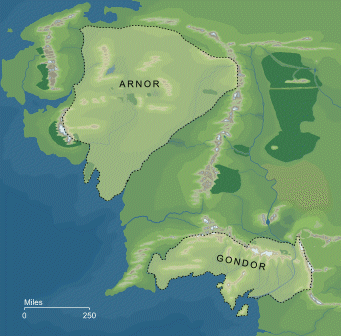
For this post, I want to explore the people and history of Bree and do so by looking at some maps of it in relation to the old kingdoms. I think this is very important because it sets the stage for why Bree is easily the most diverse village we see during the trip (including the much larger city of Minas Tirith) and why its important that the Hobbits experience this first.

First, the Bree folk claim to be original inhabitants of the land, there long before the Kings came across the sea (meaning the Numenoreans) so Bree is an old village indeed. In fact, when Arnor (the northern kingdom was established) they simply said Bree was within their borders and the Bree-landers readily agreed.

The men of Bree are likely akin to the Dunlenders (remember those folks that hate Rohan so much?) as native men who never crossed the sea and settled west of the Misty Mountains. By the same token, they are both closer related to the Rohirrim than they are to Aragorn or the other individuals of Numenorean blood.

Here are several maps centered on Bree land that illustrates its importance. To understand it completely, a quick history lesson on the time periods we're talking about

1) Pre-Numenoreans

  • Bree is settled by indigenous population of men
  • Settled pre-third age so over 3,000 years earlier!

2) Claimed by Arnor
  • Arnor was the Kingdom of the North of the Numenoreans who settled in Middle Earth. Gondor was the southern kingdom.
  • Arnor was the more powerful, and the king ruled from Annuminas, which is directly north of the Shire and a ways northwest of Bree

3) Disputed between the kingdoms
  • After 800 years of consecutive rule in the North, the King died and his three sons cannot decide who should rule.
    • Annuminas, the former capital, is now in ruins after neglect.
    • New capital, 100 miles north of Bree called Fornost is created.
    • They split the kingdom in three
      • Arthedain - the biggest and where the line of Isildur (Aragorn's ancestors) continue to rule. Rules from Fornost, claims Bree and also controls Weathertop
      • Cardolan - south of Arthedain, also claims Bree, but less powerful
      • Rhudaur - From Weathertop to Rivendell and north, this kingdom is hills and forests and little else
  • Angmar is located just to the north of Rhudaur and Arthedain and so the Witch-King places a puppet of his on the throne of Rhudaur. Angmar and Rhudaur team up to fight Arthedain and Cardolan.
  • After long period of wars, Angmar wins, crushes Arthedain and destroys Fornost
    • Note that this is over 1,100 years after the kingdoms split
  • The last King of Arthedain is slain  (Arvedui) and his son Aranarth decides not to rebuild the kingdom and becomes the first Chieftain of the Dunedain.

4) Free City
  • Sometime during the rule of Arthedain and gigantic plague swept Middle-Earth reducing the populations substantially. This is why Bree is the largest city of men north of Edoras and is a village of ~100 houses
  • Still on major crossroads, but with the fall of the kingdoms, there is no North-South road and the grass retakes the old trail.

Alright, that was a lot to take in so I won't add much more. Essentially, Bree has been at the center of action for thousands of years and although never the seat of kings or the site of great battles, has been a vital trading location and a gateway between the North and the South and the East and the West.

For the Hobbits, Bree is their gateway from a land of comfort and familiarity, to a grim and unforgiving world that is not much to their liking.


(Please comment with questions on history or if I seemed to just blaze over details. I tried to condense an awful lot of information into a short post and hope it was informative.)

Monday, April 15, 2013

Chapter 8: Fog on the Barrow-Downs

(I'm doing something new here where I bold and italicize Tolkien's words to draw more emphasis to them. Let me know if it helps or if I should do it differently)

In this chapter, Frodo and company set out across the foreboding Barrow-downs and are, of course, snatched by the wights into danger.

When Frodo comes to after fainting, he is in a Barrow - he assumes - and is flat on his back on a stone table with his arms crossed on his chest (remember, this is a tomb after all...) Looking around, the other Hobbits on on the ground near him but it is an otherwise empty room. The others look asleep or, worse, dead!

This is an important chapter because it really does define Frodo as courageous, much moreso than he appears in the films.

Under the Spell of the Barrow Wights by Ted Nasmith

Frodo's Courage

Upon looking around, Frodo at first feels frightened which is pretty understandable considering the dark tales of the Barrow-downs that have been his only experience with the region. Instead of cowering as one might expect, Frodo feels a stirring a courage and he thinks of words that Bilbo had often shared.

"There is a seed of courage hidden (often deeply, it is true) in the heart of the fattest and most timid Hobbit, waiting for some desperate danger to make it grow." Tolkien then explains how highly Gandalf and Bilbo thought of Frodo, considering him the best Hobbit in the entire Shire - which is quite high praise coming from this pair!

Frodo puts this into action as he sees a dismembered hand creep its way toward Sam. He grabs a nearby blade and hacks at the hand, keeping it away from his friends. 

This is the first act of clear and expressed violence in the book and it is Frodo who does it to save his friends. I think this is significant in defining his progression as a character and as a "trendsetter" of sorts among the Hobbits.

Fear grips Frodo again, however, as he hears the terrible chanting of the barrow-wights. Once again, Frodo finds courage and begins softly signing Tom Bombadil's song to call him to the Hobbit's side. The words bolster him as he sings and by the end, Tom has arrived by breaking down a wall to the room.

Tom promptly banishes the wights through his songs, shouting them down, proclaiming that his songs are stronger songs. (Power of the voice, yada, yada, yada)

Tom's Memory

After saving the Hobbits, Tom gathers up the treasure of the Barrow and sets it upon the now sunlit hilltop for all creatures to come and take as needed. He gives the Hobbits each a sword of old Arnorian make (back when Aragorn's ancestors ruled the North) which are still quite powerful. Upon giving these Tom comments on the swords' importance "Few more remember them,  yet still some go wandering,  sons of forgotten kings walking in loneliness,  guarding from evil things folk that are heedless"


Tom is talking about the Rangers of course! Wonder why the Shire hasn't seen any violence since wolves invaded a few centuries before? The Rangers. Why it is so strange to hear of evil things even around Bree where Hobbits have spent a good deal of time? The Rangers. 

The Hobbits, or Frodo at least, also receive another vision here on the expanse of the years since the forging of their new blades. They see lines of marching men, tall and grim in bright series, and the last among them came with a star upon his brow.  The reader who is familiar with the series knows that this is Aragorn, who is called Elessar (elf-stone) for the symbolic "star of Earendil" that the line of kings wore.

I only noticed this on a later read-through but this really sets up Aragorn much better than I had initially thought, and Toms words describes Aragorn, their leader, impeccably.

Tom also takes a small brooch adorned with blue stones for himself, saying "fair was she who long ago wore this on her shoulder" I took great interest in this quote when reading through this current time and thinking about who this lady was. Tom speaks of this brooch as if remembering a fond memory of ancient times. Similarly, it must have been long ago indeed if Tom is calling it long ago. This guy was there at the dawn of time remember?

I have come to two theories, each of which are plausible and there really isn't much else to help determine which one could be true

Theory 1: Luthien
The story of Beren and Luthien is one of Tolkien's best known works of the 1st Age (LOTR takes place in the 3rd Age) telling of the human Beren going through great, unbelievable tasks (like the tasks of Hercules) to be with the Elven-born Luthien.

Luthien is described as the most beautiful thing to have ever lived and her romance with Beren is the best love story that Tolkien wrote (Aragorn and Arwen are like a watered down parallel story to this). The brooch would presumably have been passed down through Luthien's descendents to her grandchildren Elros and Elrond. Elros chose to become a human, unlike his twin brother Elrond (yes, THAT Elrond) and Elros became the first King of Numenor and the ancestor to Aragorn. This brooch would have passed down the lines and eventually been in the hands of the rulers of the old Northern kingdom of Arnor when Aragorn's ancestors Elendil and Isildur ruled it. Eventually, it was lost with the rest of the Northern kingdom when the Witch-king invaded.

This theory also has some plausibility as Aragorn wears the Ring of Barahir, a legendary heirloom of his house that was traced back to Beren - Luthien's husband. I love the symbolism of the two relics being passed through the generations and one being lost represents the fall of the kingdom. When Tom recovers it, it's a sign that the dark days are done and the Return of the King is soon!

Theory 2: Noble lady of Arnor/Queen of Arnor
Similar to Theory 1, this places the brooch as an item of importance to the history of Arnor. Presumably, this brooch belonged to a noble lady, maybe even a queen, who met with Tom and Goldberry long ago before their kingdoms fell. This would perhaps fit better with the casual way that Tolkien describes the brooch without placing much importance on it.

Conclusion:
I'm going to keep thinking it belonged to Luthien. I love the parallel with the Ring of Barahir, and the ties to Tolkien's favorite female character (his wife's tombstone has the name "Luthien" engraved on it). I also think that it fits with Tom's reckoning of time (a few ages back was definitely a long time ago, even for him), and Tolkien is also not very descriptive of Glamdring, Gandalf's sword, when they find it in "The Hobbit." Glamdring was wielded by Turgon, one of the most powerful Elven kings to have lived, a fact that Gandalf surely would know since he knew the name of the sword, yet Tolkien omits it. Important historical things are not always called out explicitly by Tolkien.

In any case, I love moments like this where I can create my own reasoning for what something is and how it ties together. What do you think the brooch is?