Showing posts with label 1st Age. Show all posts

Wednesday, May 22, 2013

Deus ex Glorfindel


While we don't have an Elven princess rolling in on a white horse to save the day, we have an immensely powerful Elf-lord from the 1st Age who finds the party and guides them back towards Rivendell. Similar concept, but more believable in Tolkien's words, I feel. I mean, the Nine are pretty much the most badass things outside of Sauron and Saruman in terms of wicked things (not counting Durin's Bane), but yet Elrond sends his daughter - and only child - to find Aragorn and the Hobbits?

Come on.

Anyway, I'm over that because Glorfindel is just too cool.

Glorfindel is a character who also appears in the Silmarillion where he is a lord of Gondolin, the last great Elven kingdom in the First Age, and the site of one of the Silmarillion's most famous scenes. The Fall of Gondolin is the story of how Morgoth found the location of the last Elven kingdom that defied him and sent his hordes of dragons, balrogs, and orcs to take it. The Fall of Gondolin is also the earliest story that Tolkien wrote. The earliest part is from 1916, when he wrote while in the trenches of World War 1. This is a full forty years before LOTR is published. Crazy.

Glorfindel was a powerful lord of the city and fought fiercely, including 1-1 combat with dragons to buy time for his House to escape. It was during this battle that Ecthelion, Captain of the Gondolin Guard, faced the chief of the Balrogs - Gothmog - in single combat AND WON!

But while Ecthelion is being a mad boss, he also died during the fight and won on the technicality that he just pushed Gothmog into the central fountain which extinguished his flame, killing Gothmog. Technicality.

Glorfindel and the Balrog by Ted Nasmith


Glorfindel is continuing to leading the people of the city out through secret ways and they are ambushed by an army of orcs lead by another Balrog! This time, Glorfindel faces him 1-1 and after a long and tiring combat, defeated the Balrog fairly and decisively. As the Balrog fell from the mountain, he reached up and grabbed Glorfindel, pulling him to his death. 

This action allowed the human hero Tuor to survive. Tuor is the most famous man of the First Age (outside of his cousin Turin) and is the only human to ever earn the honor of sailing to Valinor and becoming immortal. What a boss.
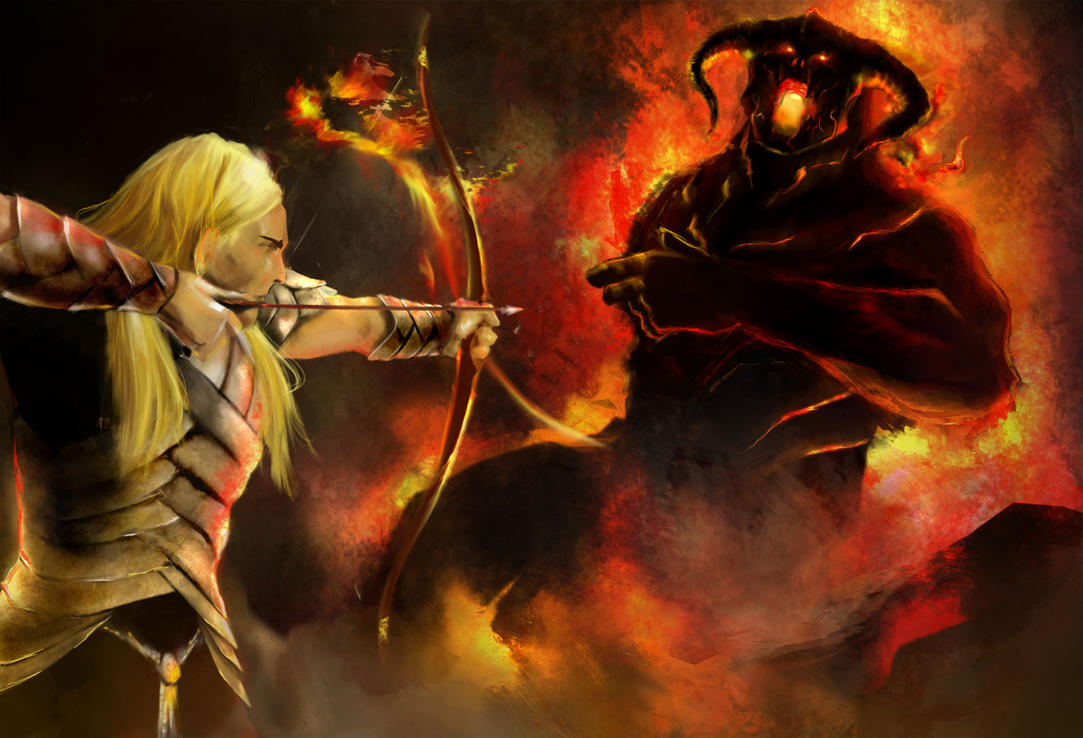
Glorfindel and the Balrog by HectorBetancur


Because of Glorfindel's bravery and pure dedication to saving his people, his spirit was revived by Manwe so he could live again. LITERALLY, DEATH CANNOT BEAT THIS DUDE.

So Glorfindel spends the next several hundred years in Valinor where he is now nearly as powerful as the Maiar (Gandalf, Saruman, Sauron, etc). He spends a lot of time with Olorin (Gandalf's name before he came across the sea) and they became good friends. Sometime around the forging of the Ring, Glorfindel returns to Middle-Earth to aid Gil Galad and Elrond in their fight against Sauron.

So this bad-ass is the one that Elrond sends to find Frodo.

I'm a huge fan of Glorfindel and he is one of my favorite characters in the entire legendarium.

Tuesday, May 7, 2013

Morgoth and the 1st Age

After Brandon's comment on my "Knife in the Dark" post, I realized that I've neglected to provide any background on an important, if rarely mentioned character - Melkor, the original big bad guy whom the Elves call Morgoth or "Black Foe".

First thing to understand is that the Valar are divided into two "castes" for lack of a better word. At the beginning of time, the Ainur (the "higher" ranked caste) joined with Eru (the one God) to sing the world into creation. Melkor was the greatest among the Ainur and Eru's most trusted servant. While the other Ainur had individual realms that they ruled (for example: Ulmo - the sea, Orome - wildnerness, the hunt) Melkor held sway in each of these areas. So he was pretty damn powerful.

One of the big themes in the Silmarillion is the idea of the "creator". Tolkien's personal beliefs made him uncomfortable creating a polytheistic world and so he made a singular deity (Eru) above the "pantheon" he had already created. One of the outcomes of this was that only Eru has the power to create, which he does by creating the Elves and Men in Middle-Earth.

We can contrast with the story of the Dwarves. Aule, the Smith of the Valar, labored under the mountains of Middle-Earth and created the seven Dwarf fathers but he could not give them life - only Eru has that power. When Eru discovered, Aule offered to destroy them since he did not have the ability or permission to create, but Eru stayed his hand and gave the Dwarves life, but they could only awake after the Men and Elves did.

Now, Melkor was not humble about this ability like Aule was. He was a bit jealous of the ability to create and wanted to create his own ideas.

During the initial song of creation, Eru gave each Valar the notes that they needed to sing in order to create the world. Melkor decided to edit his parts and create something original. This change did not fit in with Eru's plan, and Melkor's new notes created discord in the song which is what Tolkien used to explain how bad things entered the world. The discord in the song created strife, pain, and suffering.

Morgoth by Ted Nasmith


Cast Out of the Valar

His strength of song was praised by Eru but he was admonished for being selfish and everafter, Melkor resented the other Valar and actively waged war against them.

When the Elves first awoke, Melkor was the first to encounter them and swayed many to his side, corrupting them into the Orcs. This is an important distinction because he did not CREATE the Orcs, only corrupted what already existed.

With the Orcs, evil men, as well as many other terrible and fell servents - spirits of the world manifested like Glaurung the father of all Dragons, or corrupted Maiar (which are the lower "caste" of the Valar) like Sauron - Melkor waged war against the Valar and caused much strife.

The Valar eventually assaulted Utumno, Melkor's fortress, and captured him. Chained in unbreakable chains, he was imprisoned in Mandos (purgatory) for a long, long time. After this, he pretended to be repentant and the Valar bought it because they didn't understand evil or the depth of Melkor's fall. 

He began to spread lies quietly among the Elves, sowing anger and dissent against the other Valar. The most vocal of these Elves was Feanor, a powerful lord and the greatest Elvish craftsmen to ever live. Feanor was brought before Manwe (think Zeus) for judgement and Melkor's lies were discovered leading to another massive manhunt for him. But Melkor evaded them and continued to seek the Silmarils - legendary, perfect jewels crafted by Feanor which not even Aule, the Smith "God" could make.

This hunt for the Silmarils and the ensuing back and forth conflict is known as the Silmarillion...

The Fall

Anyway, I want to save most of the Silmarillion for another time because there is just too many great stories. Beren and Luthien takes place here, as does the story of Turin Turambar, the greatest warrior who ever lived. And as mentioned before, Feanor is a fantastic character. He is Tolkien's Elvish equivalent to Original Sin and his story arc is very distinct from most Elves we encounter. We can have separate posts for each.

But Melkor is renamed Morgoth by Feanor meaning "Black Foe" and this is how he is known by later generations. Eventually, the Host of Valinor, led by brave lords of men and Elves and with the Valar joining as well. They capture Morgoth, bind him again, and this time cast him out into the "Void", the netherworld between worlds where he cannot escape.

His legacy lives on through Sauron who was his top lieutenant and inherited control over the fell creatures and the Orcs. The prophecy states that Morgoth will eventually escape his chains and return to the world causing the Dagor Dagorath or the apocalypse. At this time, Manwe (Zeus) will unleash all of the dead spirits and the full might of the Valar against the renewed hosts of Morgoth.

Hope this was useful in explaining more about the Great Enemy that is occasionally referenced in the Lord of the Rings but never explained!