Showing posts with label Courage. Show all posts

Monday, June 29, 2015

Boromir: "You have conquered."


In the film version of Fellowship of the Ring, Boromir’s death is one of two final emotional finishes that sets the next film’s diverging storylines apart. 

Boromir’s arc is that of a classic tragic hero with some Biblical inspirations driving his actions. Instead of discussing the content of the first chapter of The Two Towers (TT), I want to take a post to examine Boromir’s life, death, and impact.

Boromir the Man

Boromir is the eldest son of Denethor, Steward of Gondor, and one of the foremost military leaders in Gondor. As he is of the line of Stewards, Boromir also has some Numenorean blood (the same blood that Aragorn has) but because it has been diluted so much over the years, the effects are not as pronounced as they are in the Dunedain who live to be 200. This blood, and Boromir’s pride in his bloodline, helps explains his disdain for Aragorn from the earliest meeting in Rivendell. The Stewards rule Gondor, the line of Kings is extinct.

Gondor’s identity since the death of the last King Isildur has been centered around a constant tug of war with the remaining orcs of Mordor, with struggles to keep shipping lanes free of the pirate lords of Umber, and economic difficulties of an empire in decline. War is constant, and strong leaders are necessary to inspire and rally the soldiers through such never-ending conflict.

Boromir is the latest in a line of extraordinarily tough men who place their duty and service to Gondor above all.

Boromir the Savior

As I’ve mentioned, Boromir is a very capable military leader and is willing to sacrifice much for the good of Gondor. He sees the forces they fight against getting stronger. The Orcs of Mordor are more organized, raiders from the far east harass the borders and the Pirate Lords of Umber are more active. Boromir is desperate for an answer to save his people for whom he has given everything.
In a scene very reminiscent of Biblical prophecy and visions, Faramir, Boromir's younger brother receives a vision one night telling him to go north to find a way to save Gondor. Boromir knows the journey is dangerous and insists on undertaking the quest to save Gondor over his brother who actually received the original vision (he received the same vision a few days later). He recounts this to Aragorn during a brief meeting in Rivendell saying,

"In that dream I thought the eastern sky grew dark and there was a growing thunder, but in the West a pale light lingered, and out of it I heard a voice, remote but clear, crying:
Seek for the Sword that was broken:
In Imladris it dwells;
There shall be counsels taken
Stronger than Morgul-spells.
There shall be shown a token
That Doom is near at hand,
For Isildur's Bane shall waken,
And the Halfling forth shall stand."
Boromir believes that he has been chosen specially to save Gondor and must find the means of doing it.

Boromir the Fallen

Boromir is immensely frustrated by the Council of Elrond. His weapon to defeat the encroaching darkness is apparent (the Ring) but out of his reach, and a ranger from the north claims to be the long-lost heir to the throne of Gondor. 

His worldview is shattered. Not only is the weapon that he yearns for just out of reach behind a meddling wizard, a bunch of foreigners with no concept of the dangers facing the world of men, a pretender to Boromir’s own birthright, and a bunch of halflings. To Boromir, this is deeply frustrating.

Is it not a strange fate that we should suffer so much fear and doubt for so small a thing? So small a thing!

However, during times of turmoil, Boromir’s instincts and true self reveal themselves. He works with Aragorn and the others to pull the Fellowship through Moria. He rallies the group when Gandalf is lost to the depths with the Balrog. He comes to respect his companions as capable and earnest even if they do not share the same end goal.

It is in idle times where Boromir’s descent manifests and the Ring can seize hold. At Amon Hen, the Ring’s pull becomes too much for Boromir and he confronts Frodo, trying to seize the Ring by force.
Frodo escapes and Boromir regains his senses but is horrified at his own actions. 

The Ring has taken his noble goals and twisted them into a perversion that nearly consumes him. Would Faramir have been as susceptible? Would the Fellowship have broken anyway?
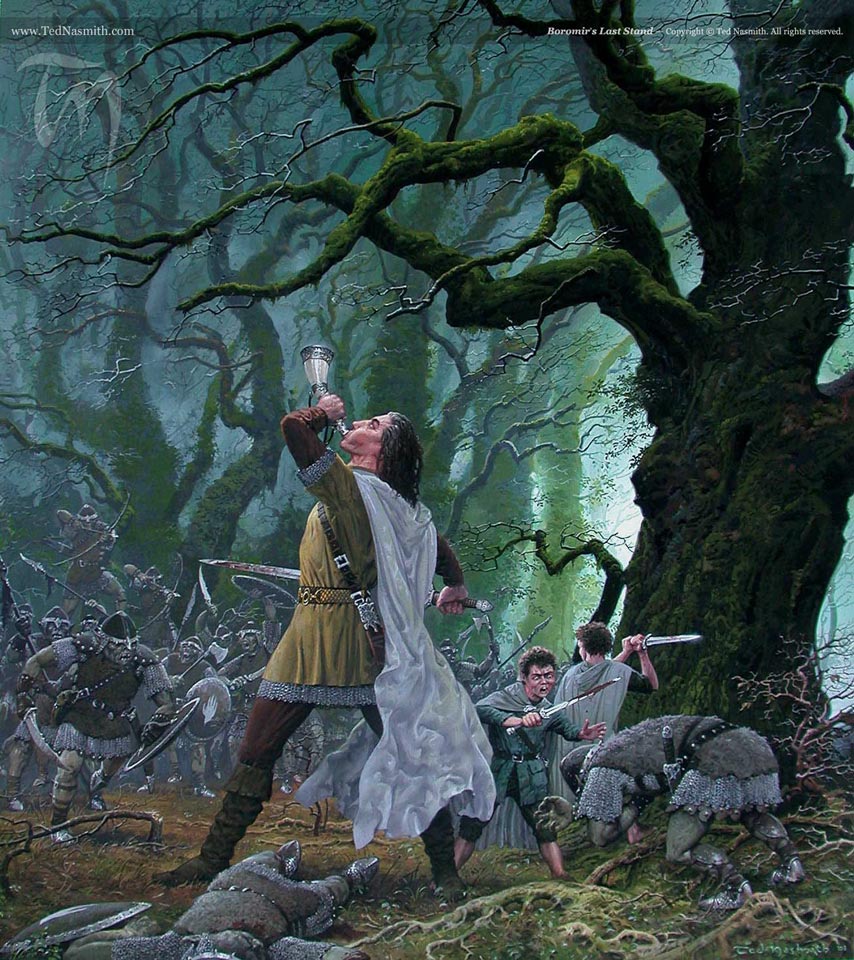
"Boromir's Last Stand" by Ted Nasmith


Boromir the Redeemed


Boromir immediately recognizes that something else had a hold of his heart, twisting his desires. However, Boromir blames himself immensely for his own failing and weakness.

I’ll explore Aragorn’s Jesus Christ parallels in a later post (Return of the King probably) but I think Boromir pulls heavy from messianic mythology as well. Boromir is tempted, nearly fatally, by the power of the Ring. Temptation pulls at him, gnawing on his thoughts, and perverting his intentions. The Ring has some serious Satan parallels.

But Boromir, not fully through his own power, overcomes this temptation and repents wholeheartedly. He sobs over his own human fragility and weakness, yearning for a way to prove his worth.

When the Uruk-Hai attack, Boromir eagerly jumps to defend, knowing that they must be after the Ringbearer. As depicted in the film, he mounts a truly impressive stand, fighting with all his might to overcome his own shortcomings. As he lay dying from a thousand small wounds and few large ones, Aragorn is there to hear his final words.
“'Farewell, Aragorn! Go to Minas Tirith and save my people! I have failed.'”
Aragorn’s response completes the redemption.
“You have conquered. Few have gained such a victory. Be at peace!”
Boromir did not give in fully to the Ring. Despite the temptation, he overcame. Boromir smiles as he dies on Amon Hen.
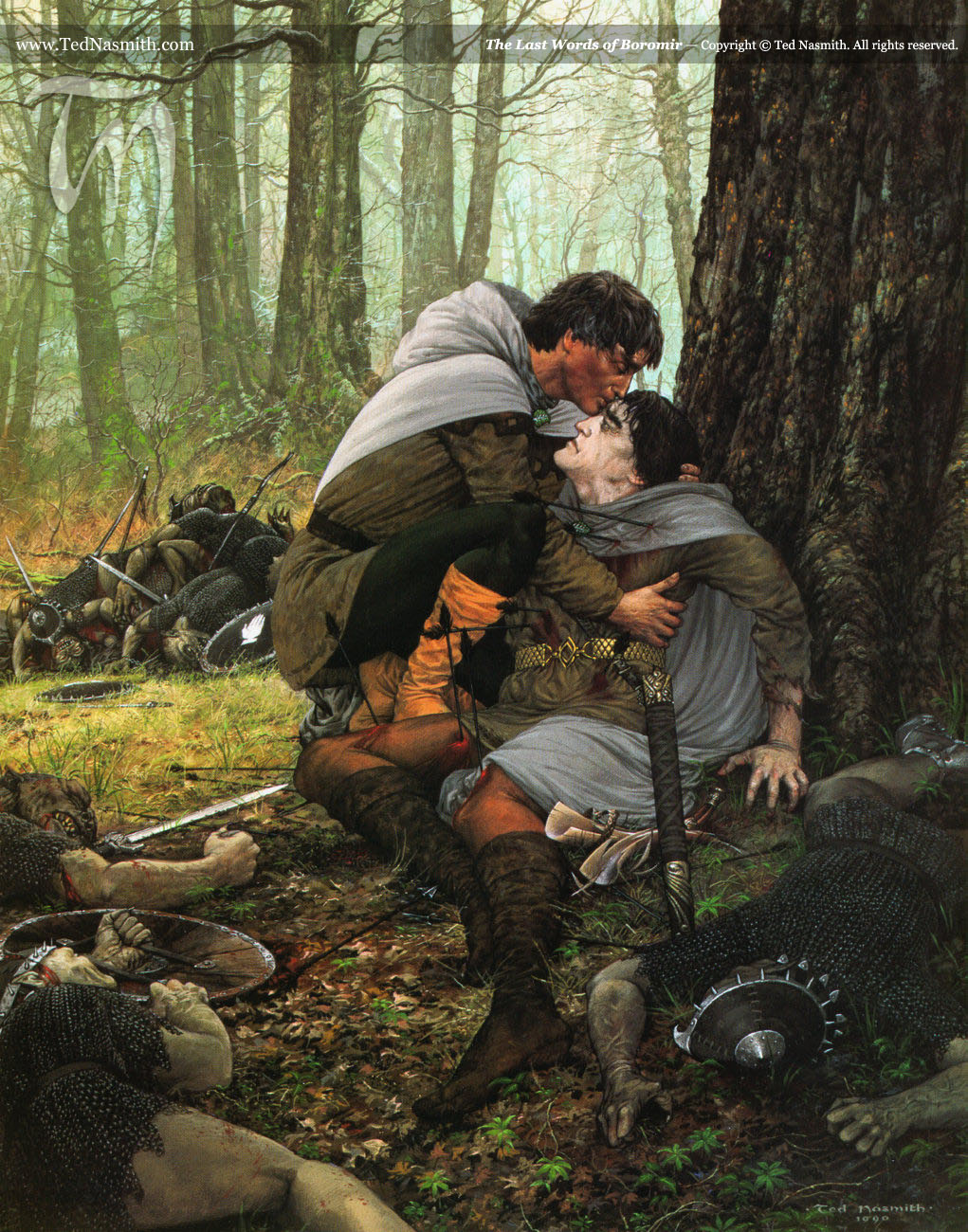
"The Last Words of Boromir" by Ted Nasmith

Boromir’s Legacy

Boromir’s rise, fall, and ultimate rise is the story of the Ring in general. The Fellowship starts with such strong convictions and promise and is promptly broken barely across the mountains. From there, the scattered members must find a way to achieve their goals despite of the formidable odds against them. 

Boromir overcame his own formidable odds and became the first Gondorian to acknowledge Aragorn could be the protector of Gondor that he could not be. Boromir’s stand defending the hobbits inspired Pippen to join Denethor’s forces and contribute to the defense of Gondor himself. Boromir’s death and final words charged Aragorn with the protection of Gondor as their new captain.

The death of Boromir is the sledgehammer physically breaking the Fellowship apart. Without Boromir’s temptation and ultimate sacrifice, no one else could have achieved their end goals.
Boromir was a true hero.

Faramir of the Fellowship

What would've happened if Faramir and not Boromir was sent to Rivendell? I tend to believe the Fellowship still would have broken but perhaps at a later point. Frodo was already becoming suspicious of everyone else even without Boromir and it was probably going to happen soon anyway. However, Faramir would have been much more cautious in approaching the Council of Elrond and would likely have been more accepting of Aragorn. If he survived to make it back to Gondor, it could have made a large difference.

Conversely, leaving Boromir in Gondor could have decimated Gondor's remaining forces if he stretched them too thin or pushed too hard instead of Faramir's hit and run, cautious defence.

The Fellowship could've lasted while Gondor burned? Any thoughts?

Wednesday, September 4, 2013

Book 2 Chapter 5: The Bridge of Khazad-Dum

First off, the last post pushed me over 1,000 lifetime views which is pretty cool. Thanks for reading my ramblings on here. I hope I'm providing a bit of insight and some thought provoking ideas but will settle for a few pity reads. 

Thank you for the pity reads.

The Bridge of Khazad-Dum is one of the most memorable chapters in Tolkien due primarily to the loss of Gandalf into the darkness of Moria. This first breaking of the Fellowship is the most significant set-back thus far (which is a pretty bold statement in itself!) and shapes the entire narrative of the next four books.

Sam the Fearless Guardian

At the beginning of the chapter, the Fellowship fights for their life in the Tomb of Balin. Frodo is famously stabbed (saved by his mithril!) and everyone gets to show off their cool action-figure-y skills. (Boom, headshot! says Legolas)

During the course of the battle, Sam is the only one to receive any physical injury: a scratch across his face. Narrowly avoiding a much deeper blow, Sam thrusts his sword through the offending orc. Here's Tolkien's description:

"A fire was smouldering in his brown eyes that would have made Ted Sandyman step backwards, if he had seen it."

Can you imagine Sam doing this only a single chapter ago before they entered Moria? How about when he thought that Rivendell would be the end of their trip? Is Sam just discovering a part of himself that was always there or is he changing?

I think Sam is discovering who he really is. Shedding naivete and starting to see the broader scope of their task, Sam is building on the tenacity that was already there. It doesn't matter if it is a stubborn weed in the Gaffer's garden or an army of Orcs in Moria, if Sam needs to do something, he is going to do it.

A version of the Balrog that leans heavily on the Peter Jackson interpretation.

A Balrog is come!

Of course, despite how awesome Sam's inner ferocity is, most of y'all are going to take away just one thing from this chapter and that's Durin's Bane, a damned Balrog of Morgoth.

We discussed Balrogs a few times in previous sections and I'll probably discuss them again (because they are awesome) but the real winner here is Gandalf.

As the Fellowship fled from the Tomb of Balin, Gandalf tried to place a shutting spell on the door (not the same level as a "Cheat Code"-esque Word of Command, more like exploiting a glitch for personal gain). However, this was apparently not enough.

"I have met my match and have nearly been destroyed...I am rather shaken."

Alright, so Gandalf is appearing visually exhausted but what caused this? Just that spell? Tolkien explains,

"The counterspell (to the shutting spell) was terrible. It nearly broke me. For an instant the door left my control and began to open. I had to speak a Word of Command."

Gandalf's power hasn't been directly matched yet and here is something that stands right up to him and seems like an equal. Balrogs were once Maia (the lesser Valar) like Gandalf himself before they became corrupted by Morgoth. This gives them abilities above and beyond creatures like the Nazgul and more like Saruman or Sauron himself.

So Gandalf is pretty messed up already, but they're nearing the exit. Finally, they reach the bridge which was built as an ancient defense, forcing armies to walk single-file across bridge. I can't describe the scene any better than Tolkien himself did so here it is, in his own words:

"It came to the edge of the fire and the light faded as if a cloud had bent over it. Then with a rush it leaped across the fissue. The flames roared up to greet it and wreathed about it; and a black smoke swirled in the air. Its steaming mane kindled, and blazed behind it. In its right hand was a blade like a stabbing tongue of fire; in its left it held a whip of many thongs."

Gandalf's Speech


Legolas basically craps himself when seeing the Balrog and Gimli is dumbstruck over seeing Durin's Bane in person. Gandalf stands alone on the bridge urging the Fellowship on. Turning on the Balrog, Gandalf defies him with probably the most iconic line in the story.

"You cannot pass!"

That's right. Cannot pass. This is different than the films but unlike most of the minor changes, this one is important. "You CANNOT pass" makes it a physical impossibility. The Balrog literally cannot physically pass the bridge. Gandalf's words are not idle threats or taunts at Durin's Bane, they are proclamations of law.

"I am a servant of the Secret Fire, wielder of the flame of Anor. You cannot pass. The dark fire will not avail you, flame of Udun. Go back to the Shadow. You cannot pass."

He may have been challenged before by the Balrog but he did not know his opponent at that time. Now, he knows what he faces and specifically how to defeat it.

To do so, he is invoking some powerful phrases here. Let's break it down.

"Servant of the Secret Fire"

To Tolkien, the Secret Fire was what we would refer to as the "Holy Ghost" or "Holy Spirit". It's the surrounding factor in our lives that emanates from Eru (God) and breathes life into the world. Gandalf is invoking the supreme directly, bypassing the Valar and the Balrog's original master Morgoth. This is the most powerful force in Middle-Earth.

"flame of Anor"

Anor is the sun, which is a fire and light that gives us life. Without the sun's fire, we couldn't exist. This reinforces Gandalf as a servant of fire, like Sauron and the Balrogs, but unlike them, he is a servant of the "good" fire.

"flame of Udun"

Tolkien likes his fire metaphors. The flame of Udun is conversely, the flame of darkness or the flame that destroys. Fire can be a fantastic tool for growth, culling brush so that forests may thrive and providing sustenance and warmth for survival. However, taken too far, fire can destroy absolutely. 

Conclusion

Tolkien uses fire as a common metaphor because it is precisely the theme of the overall story. The Lord of the Rings  is about the corrupting nature of power and that while some power is needed to accomplish great things (Aragorn, Frodo, and Sam each wield a certain "power") but taken too far, this power can bring anyone to ruin including those who wish to use the power for good (Saruman).

Fire, like power, is necessary in the world but a balance is needed otherwise the fire will consume you.


Monday, April 15, 2013

Chapter 8: Fog on the Barrow-Downs

(I'm doing something new here where I bold and italicize Tolkien's words to draw more emphasis to them. Let me know if it helps or if I should do it differently)

In this chapter, Frodo and company set out across the foreboding Barrow-downs and are, of course, snatched by the wights into danger.

When Frodo comes to after fainting, he is in a Barrow - he assumes - and is flat on his back on a stone table with his arms crossed on his chest (remember, this is a tomb after all...) Looking around, the other Hobbits on on the ground near him but it is an otherwise empty room. The others look asleep or, worse, dead!

This is an important chapter because it really does define Frodo as courageous, much moreso than he appears in the films.

Under the Spell of the Barrow Wights by Ted Nasmith

Frodo's Courage

Upon looking around, Frodo at first feels frightened which is pretty understandable considering the dark tales of the Barrow-downs that have been his only experience with the region. Instead of cowering as one might expect, Frodo feels a stirring a courage and he thinks of words that Bilbo had often shared.

"There is a seed of courage hidden (often deeply, it is true) in the heart of the fattest and most timid Hobbit, waiting for some desperate danger to make it grow." Tolkien then explains how highly Gandalf and Bilbo thought of Frodo, considering him the best Hobbit in the entire Shire - which is quite high praise coming from this pair!

Frodo puts this into action as he sees a dismembered hand creep its way toward Sam. He grabs a nearby blade and hacks at the hand, keeping it away from his friends. 

This is the first act of clear and expressed violence in the book and it is Frodo who does it to save his friends. I think this is significant in defining his progression as a character and as a "trendsetter" of sorts among the Hobbits.

Fear grips Frodo again, however, as he hears the terrible chanting of the barrow-wights. Once again, Frodo finds courage and begins softly signing Tom Bombadil's song to call him to the Hobbit's side. The words bolster him as he sings and by the end, Tom has arrived by breaking down a wall to the room.

Tom promptly banishes the wights through his songs, shouting them down, proclaiming that his songs are stronger songs. (Power of the voice, yada, yada, yada)

Tom's Memory

After saving the Hobbits, Tom gathers up the treasure of the Barrow and sets it upon the now sunlit hilltop for all creatures to come and take as needed. He gives the Hobbits each a sword of old Arnorian make (back when Aragorn's ancestors ruled the North) which are still quite powerful. Upon giving these Tom comments on the swords' importance "Few more remember them,  yet still some go wandering,  sons of forgotten kings walking in loneliness,  guarding from evil things folk that are heedless"


Tom is talking about the Rangers of course! Wonder why the Shire hasn't seen any violence since wolves invaded a few centuries before? The Rangers. Why it is so strange to hear of evil things even around Bree where Hobbits have spent a good deal of time? The Rangers. 

The Hobbits, or Frodo at least, also receive another vision here on the expanse of the years since the forging of their new blades. They see lines of marching men, tall and grim in bright series, and the last among them came with a star upon his brow.  The reader who is familiar with the series knows that this is Aragorn, who is called Elessar (elf-stone) for the symbolic "star of Earendil" that the line of kings wore.

I only noticed this on a later read-through but this really sets up Aragorn much better than I had initially thought, and Toms words describes Aragorn, their leader, impeccably.

Tom also takes a small brooch adorned with blue stones for himself, saying "fair was she who long ago wore this on her shoulder" I took great interest in this quote when reading through this current time and thinking about who this lady was. Tom speaks of this brooch as if remembering a fond memory of ancient times. Similarly, it must have been long ago indeed if Tom is calling it long ago. This guy was there at the dawn of time remember?

I have come to two theories, each of which are plausible and there really isn't much else to help determine which one could be true

Theory 1: Luthien
The story of Beren and Luthien is one of Tolkien's best known works of the 1st Age (LOTR takes place in the 3rd Age) telling of the human Beren going through great, unbelievable tasks (like the tasks of Hercules) to be with the Elven-born Luthien.

Luthien is described as the most beautiful thing to have ever lived and her romance with Beren is the best love story that Tolkien wrote (Aragorn and Arwen are like a watered down parallel story to this). The brooch would presumably have been passed down through Luthien's descendents to her grandchildren Elros and Elrond. Elros chose to become a human, unlike his twin brother Elrond (yes, THAT Elrond) and Elros became the first King of Numenor and the ancestor to Aragorn. This brooch would have passed down the lines and eventually been in the hands of the rulers of the old Northern kingdom of Arnor when Aragorn's ancestors Elendil and Isildur ruled it. Eventually, it was lost with the rest of the Northern kingdom when the Witch-king invaded.

This theory also has some plausibility as Aragorn wears the Ring of Barahir, a legendary heirloom of his house that was traced back to Beren - Luthien's husband. I love the symbolism of the two relics being passed through the generations and one being lost represents the fall of the kingdom. When Tom recovers it, it's a sign that the dark days are done and the Return of the King is soon!

Theory 2: Noble lady of Arnor/Queen of Arnor
Similar to Theory 1, this places the brooch as an item of importance to the history of Arnor. Presumably, this brooch belonged to a noble lady, maybe even a queen, who met with Tom and Goldberry long ago before their kingdoms fell. This would perhaps fit better with the casual way that Tolkien describes the brooch without placing much importance on it.

Conclusion:
I'm going to keep thinking it belonged to Luthien. I love the parallel with the Ring of Barahir, and the ties to Tolkien's favorite female character (his wife's tombstone has the name "Luthien" engraved on it). I also think that it fits with Tom's reckoning of time (a few ages back was definitely a long time ago, even for him), and Tolkien is also not very descriptive of Glamdring, Gandalf's sword, when they find it in "The Hobbit." Glamdring was wielded by Turgon, one of the most powerful Elven kings to have lived, a fact that Gandalf surely would know since he knew the name of the sword, yet Tolkien omits it. Important historical things are not always called out explicitly by Tolkien.

In any case, I love moments like this where I can create my own reasoning for what something is and how it ties together. What do you think the brooch is?