Showing posts with label Aragorn. Show all posts

Monday, October 28, 2013

Book 2 Chapters 8 and 9: Farewell to Lorien and the Great River

I decided to combine these two posts because Lorien really marks a turning point and these two chapters, though having different events and themes, tie together very well.

Galadriel's Gifts

In "Farewell to Lorien", the most significant event is the ceremonial departure from the land where Galadriel bestows upon the Fellowship great boons and treasures to help them accomplish their remaining quest. I'm going through these gifts chronologically, with the exception of Aragorn who receives the greatest gift of all.

To everyone:
  • Lembas: Elvish bread that is densely packed with nutrition and sustenance and can keep indefinitely. This is a special gift that the Elves had never previously given out to non-Elves.
  • Cloaks of the Galadrim: Elvish cloaks that excel in keeping the wearer a consistent temperature (warms and cools them) as well as "magical" properties to seemingly shift colors to hide the wearer. Pippin asks the Elves if these are magical cloaks and the Elves seem puzzled, confused by what Pippen means by "magic"
"I do not know what you mean by that. They are fair garments...lead and branch, water and stone; they have the hue and beauty of all these things under the twilight of Lorien that we love; for we put the thought of all that we kive into all that we make...You are indeed in the favour of the Lady! For she and her maidens wove this stuff; and never before have we clad strangers ub he garb of our own people." 
For how ancient Lorien is, I'd say that's a hell of a gift
Boromir
  • A belt of gold
Seemingly of little significance. I can guess that perhaps it is a reflection of Boromir's values in that a gilded belt would be "kingly" to wear and a proud leader of Gondor would be drawn to such an item? 

Merry and Pippin
  • Small silver belts, each with a clasp looking like a golden flower
Like Boromir's gift, this one doesn't seem to have any specific significance (that I can see but I'm consciously keeping an eye out while reading for further references) however, even without more significance, Elven-made gear, as previously stated, is precious and worthy of respect.

Legolas

  • A bow that the Galadrim use which is stronger than the bows Legolas had previously used from Mirkwood.
He later uses this to shoot down a Fell Beast as the Fellowship travels down the Great River so it has a certain "oomph" to it.

Legolas Draws the Bow of Galadriel by Michael Kaluta
Sam
  • A small box of earth from Lorien blessed by Lady Galadriel
This bit of dirt promises that "though you should final all barren and laid waste, there will be few gardens in Middle-Earth that will bloom like your garden." We can revisit this gift at the end of the story when Sam DOES return to the Shire but this is clearly one of the first gifts that has strong significance to the character beyond prowess in battle or armor.

Gimli

  •  Three strands of Galadriel's hair
    • Galadriel does not have a gift prepared for Gimli and instead asks Gimli "what gift would a Dwarf ask of the Elves".
    • Gimli asks no gift of the Elves stating that is enough to have seen the Lady Galadriel herself. I don't think this is him being modest or overly respectful as it is Gimli being humbled by everything he has seen in Lorien and being too proud/stubborn to ask even more of the Galadrim.
    • Gimli does respond, and as an expert diplomat too:
"There is nothing, Lady Galadriel, nothing, unless it might be - unless it is permitted to ask, nay, to name a single strand of your hair, which surpasses the gold of the earth as the stars surpass the gems of the mine. I do not ask for such a gift. But you commanded me to name my desire."
This is extraordinarily significant. Not necessarily to the story itself but it deepens the world. Galadriel's hair is said to reflect the light of the Trees of Valinor and Feanor, the greatest of the Elven kings and the most advanced craftsmen the world had ever seen (he created the Silmarils) requested a strand of her hair three separate times and was rejected. Feanor later becomes enraged over the Silmarils and is essentially an "Elvish Original Sin" figure and this interaction hints that Galadriel has a gift of insight that is hers alone. By giving Gimli THREE strands, I think she is acknowledging the other request she had for her hair and is deeming Gimli, a fellow craftsmen, to be more pure of heart and worthy of the gift than the self-serving King Feanor. Cool stuff!

Frodo
  • Phial with the light of Earendil's star that is caught in water from Galadriel's fountain
    • "Earendil's star" is a misnomer because Earendil's "star" is actually a Silmaril. Earendil fastened a Silmaril to his brow and sailed his ship into the sky (this is Tolkien so that's not legend, that happened in the First Age). This light is therefore the light of the Silmarils which themselves captured the light of the Trees of Valinor, the source of illumination and wonder for the entire world before the Sun and Moon were created. This is the most pure and perfect light left in the world and glows all the brighter when darkness sets in.
    • The most esoteric and "magical" of the gifts bestowed on the Fellowship, the phial is second in significance only to Aragorn's gift. 
Aragorn
  • "Magical" sheath for Anduril
    • The first gift for Aragorn is a sheath that is beautifully decorated with silver and gold leaves and flowers. Gemstones shaped like Elven runes name the sword Anduril and cite the lineage of the sword. In addition to the stunning beauty, the sheath is said to protect the blade from being stained or broken even in defeat.
  • The Elfstone
    • Galadriel asks Aragorn if she can present him with any other gift and he answers that all he desires, she cannot give him (clearly, Arwen), and Galadriel has a bit of a surprise for Aragorn.
    • While she can't give Arwen herself to Aragorn, she does have a token of hers to give him: a great stone of clear green set in a silver brooch shaped like a great eagle with spread wings
"This stone I gave to Celebrian my daughter and she to hers [Arwen]; and now it comes to you as a token of hope. In this hour take the name that was foretold for you, Elessar, the Elfstone of the house of Elendil!"
A Farewell to Lorien by Ted Nasmith

The Transformation of Gimli

As mentioned previously, Gimli desires only a strand of Galadriel's golden hair as a treasure "in memory of your words to me at our first meeting. And if I ever return to the smithies of my home, it shall be set in imperishable crystal to be an heirloom of my house and a pledge of goodwill between Mountain and Wood until the end of days."

These are BIG WORDS coming from a dwarf when there has been nothing but animosity between the two peoples for centuries, even millenniums. Let's take a look at Gimli's time in Lorien and deconstruct this change in view.
\
Arrival in the Forest

Gimli is treated poorly by the Elves at the border. Haldir says they have not had friendly deadlings with the Dwarves since the "Dark Days" and that only with Legolas and Aragorn guarding Gimli will he be allowed to pass and even then, he must be blind-folded. Gimli obviously takes a dim view of this arrangement and refuses to go along with the plan. Aragorn arranges for everyone to be blind-folded making it more fair. Gimli accepts this despite Legolas' grumblings. Not a promising start.

Arrival in Caras Galdon

The party arrives to meet the Lord and Lady of the city and are immediately questioned about Gandalf and his "demise". When they relay the tale of the Balrog being found, Celeborn is full of rage, placing it upon Gimli as the representative of the folk who woke the Balrog.

"But had I known the Dwarves had stirred up this evil in Moria again, I would have forbidden you to pass our northern borders. You and all who go with you."

Galadriel is quick to step in, chastising her husband, and defending the Dwarves.
"Do not repent of your welcome to the Dwarf. If our folk had been exiled long and far from Lothlorien, who of the Galadrim, even Celeborn the Wise, would pass nigh and not wish to look upon their ancient home, though it had become the abode of dragons?
 Dark is the water of the Kheled-zaram, and cold are the springs of Kibil-nala, and fair were the many pillared halls of Khazad-dum in Elder Days before the fall of mighty kings beneath the stone."
Galadriel, in two quick lines, explains the plight of the Dwarves in a way that clearly no other race had thought of before, and also references the glory and splendor of the lost kingdom IN THE NATIVE TONGUE OF THE DWARVES. Not even Gandalf used this language to describe Moria.

Gimli is stunned a bit at first and Tolkien writes, "that it seemed to him that he looked suddenly into the heart of an enemy and saw there love and understanding." Gimli follows this realization by claiming,
"Yet more fair is the living land of Lorien and the Lady Galadriel is above all the jewels that lie beneath the Earth."

In the span of a quick conversation, Gimli's heart and entire worldview of the Elves has changed. He knows that they can have compassion and understanding for the plight of the Dwarves and this change of heart and acceptance of friendship profoundly shapes the rest of the Ring-Quest and Gimli's entire life.

The Transformation of Aragorn


 Gimli isn't the only member of the Fellowship to experience a significant character change over the course of a few dozen pages. From the time entering Lorien to the campsite near Amon Hen above the falls of Rauros, Aragorn transforms from a mysterious but capable vagabond and traveler, to a decisive and kingly leader, inspiring in presence and sight.

I think three key factors are at play here

  1. The loss of Gandalf
  2. The blessing of Galadriel
  3. Coming closer to the historic sites of Numenorean power
The Loss of the Gandalf

Undoubtedly, Gandalf's loss in Moria is a tremendous blow to the Fellowship. Their emotional, intellectual, and strategic leader suddenly disappears and Aragorn, whether he is ready or not, needs to assume the mantle of leadership.

Aragorn is already a very experienced traveler and warrior, fighting in campaigns across Middle-Earth for all manner of factions (Rohan, Gondor, the Rangers, Rivendell, etc) but this is his most important command yet due to his duties as a member of the Fellowship and as the last living heir of Isildur. With Gandalf in the Fellowship, he could focus on being the heir of Isildur and protecting Frodo without the weight of decision-making. While he would consult with Gandalf, it was clear that Gandalf's opinion held primacy most of the time and Aragorn was glad to have those opinions.

After leaving Moria, I think the party was a bit shell-shocked and Aragorn was reacting on instinct more than anything: get away from the mountain and towards Lothlorien where friends are waiting. Only through spending time in Lorien in safety can his thoughts truly settle and adapt to his new role.

The Blessing of Galadriel

I referenced Aragorn's gift above, where Galadriel literally bids him to do away with his previous monikers and titles and embrace his status as heir to the throne. Her gift, which is really Arwen's gift, signifies a unity between Men and Elves (which as I've written about previously, are very rare and incredibly important) and harkens back to a previous time when the Elves and the House of Elendil still had great might and grandeur.
"Then Aragorn took the stone and pinned the brooch upon his breast, and those who saw him wondered; for they had not marked before how tall and kingly he stood, and it seemed to them that many years of toil had fallen from his shoulders."
 Aragorn's own spirits are being lifted by the blessing of the most powerful Elf in the world (and grandmother to his own beloved) and this rejuvenation and renewed determination is clearly apparent to the rest of the company.

Nearing the Lands of Numenor

After the party leaves Lorien, they travel down the Great River towards Gondor and Mordor. After several days of travel (including an ambush by orcs which included Legolas shooting down a Fell Beast in the night...) they reach the mighty gates of the Argonath.

The Argonath is probably in my top 3 favorite locations in Middle-Earth. This is place in the river where the Numenoreans built titanic statues unweathered from the centuries of wear and tear. The twin colossuses are of Anarion and Isildur, the sons of Elendil and the Kings of Gondor and Arnor respectively.

When the Great River passes between the statues, the sheer might and power of the location cowers most of the Fellowship. Frodo can't bear to look up and even Boromir keeps his head bowed. Only Aragorn seems to revel in the power of this location.
"'Fear not!' said a strange voice behind him. Frodo turned and saw Strider, and yet not Strider, for the weather-worn Ranger was no longer there. In the stern sat Aragorn son of Arathorn, proud and erect, guiding the boat with skillful strokes, his hood was cast back, and his dark hair was blowing in the wind, a light was in his eyes: a king returning from exile to his own land.
'Fear not!' he said. 'Long have I desired to look upon the likenesses of Isildur and Anarion, my sires of old. Under their shadow Elessar, the Elfstone son of Arathorn of the House of Valandil, Isildur's son, heir of Elendir, has naught to dread!'"
That's a heck of a passage and really a marked contrast to the more cautious Strider seen earlier in the book.

The Argonath by Ted Nasmith

Conclusion

I think the transition from Moria to Lorien to the wilderness beyond is crucial in understanding several characters and their development. I also could have touched on Boromir whose mania deepens as the chapters progress or Merry who becomes more eager to contribute to the Fellowship or Sam who becomes more resolute the farther he gets from home.

I think I'd like to dedicate a whole post to Boromir and his descent into madness when he dies in the third book (first part of the Two Towers) and I'll break it down further.

Hope you enjoyed this marathon of a post, I really enjoyed reading about the transformations of Gimli and Aragorn and thinking what they mean in the larger context.

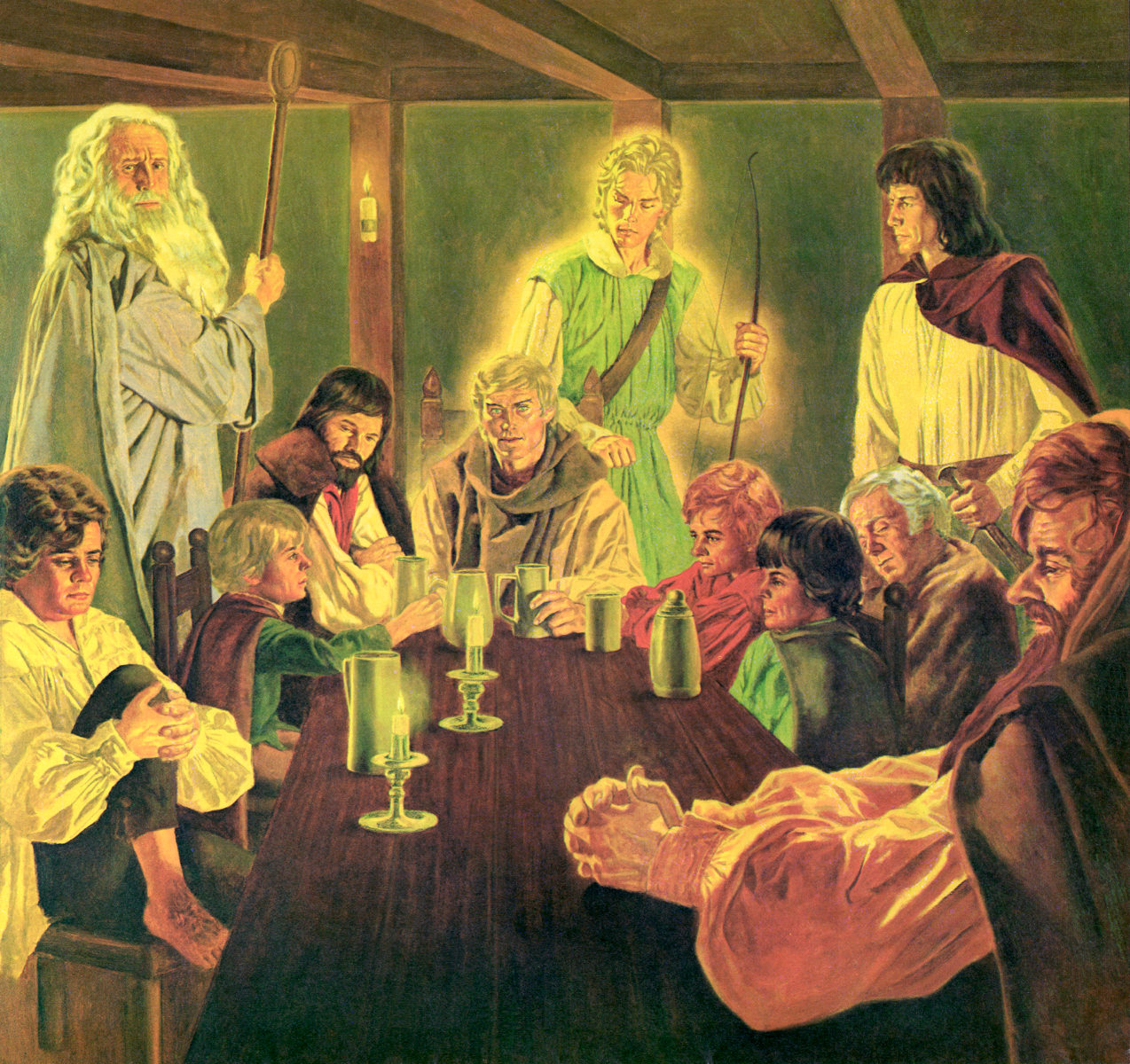
Monday, July 22, 2013

Book 2 Chapter 2: The Council of Elrond Part 1

"Council of Elrond" is one of, if not the, longest chapters in The Lord of the Rings and is chock full of information. Besides setting up the entire rest of the story plotwise, it also delves into several characters, revealing interesting information and history.

This Part 1 will focus on the attendees of the Council and Part 2 will be a deep dive into some pieces of lore glossed over in the chapter, but interesting none the less.


In this chapter, Elrond gathers the mightiest folk in Rivendell to determine what should be done with the Ring. Contrary to what I've heard from many friends speaking casually, Elrond did not "summon" the attendees or otherwise ask that they be there. Everyone just so happened to be in Rivendell at the same time. Whether this is mere coincidence or a higher power subtlety moving pieces is unknown.

Boromir

Boromir, the Captain and mightiest warrior of Gondor, is the lone representative (aside from Aragorn) of Men at the Council. Boromir is, like Aragorn, of royal Numenorean blood and therefore is more powerful, and longer lived than other men and a natural leader. However, unlike Aragorn, his blood has been more diluted over the years and is not as strong or long-lived as Aragorn or the other Dunedain. Boromir is attending the Council because he and his brother Faramir each received a vision of a great weapon that will save Gondor and he sets out to Rivendell to find it.The film version of Return of the King shows a variation of this explanation. Boromir clearly believes this weapon to be the Ring but is shot down by everyone as being too dangerous. Just what is this great weapon that Boromir was sent to find? (Hint: probably Aragorn. Like, clearly, it has to be Aragorn)

Gloin and Gimli

Gloin and his son Gimli, who we met last chapter at the feast are here to tell Elrond of odd circumstances that have happened at the Lonely Mountain. Gloin says that dark messengers came to them, offering the return of one of the Seven in exchange for information about the location of Bilbo Baggins. This is especially cruel since the Ring being offered is likely the one that was ripped from Thrain (father of Thorin Oakenshield) in the dungeons of Dol Guldor in the events preceeding the Hobbit. Gloin and Gimli also came to seek word of their cousin Balin who had attempted to recolonize Moria but had not been heard from for some time.

Legolas

Legolas and his retinue had also come to share dire news. During the long 12 year absence where Gandalf had left Frodo with the Ring and before Frodo had left the Shire, Gandalf and Aragorn had been busy bees. Gandalf knew that Gollum was the link that could tie the Ring to Bilbo and so must be caught at all costs. He and Aragorn spent years tracking through the Wild Lands for Gollum and Aragorn eventually captured him, but only after he had been tortured by Sauron for information.

Aragorn brought Gollum to King Thranduil of Mirkwood (Legolas' father) for safe-keeping. Legolas is now here to share the terrible news that Gollum escaped from their prison!

Why did the Elves simply kill Gollum and be done with it? Well, of course, it's because Gandalf urged them not to because he still hoped to find a cure for the Ring's ravaging. Remember in Moria when Gandalf admonishes Frodo for saying that it was a "pity" that Bilbo didn't kill Gollum? He leaves us with this fantastic quote: "Many that live deserve death. And some that die deserve life. Can you give it to them? Then do not be too eager to deal out death in judgement. For even the very wise cannot see all ends."

Gandalf

Touching on the end of Legolas' section, Gandalf clearly comes out in this chapter at the voice and embodiment of  the power of redemption. He truly believes that Gollum can be redeemed. Evil is NOT irreversible and even the most wicked can repent. Gandalf is one of the very few characters in Lord of the Rings where Tolkien's strong religious faith can be easily seen. Time and time again (Gollum, Grima Wormtongue, Saruman, Sauron himself) Gandalf offers his adversaries a peaceful end to renounce their wickedness.

But how did Gandalf even get to Rivendell? Last we heard, he was late to meeting Frodo in the Shire.

Gandalf set out to discuss the terrible news of the One Ring with Saruman, the wisest and most powerful of the Istari (Wizard) order. Saruman was specifically a scholar of Ring-lore; how to make them, how to imbue power into them, and what they could do. His original task in Middle-Earth was the find weakness in Sauron and help exploit them. To this end, he studied Sauron and the Ring relentlessly, becoming engrossed in his work. To this end, his fervent work consumed him.

Gandalf shared news that the Ring had been found and that they must take action to keep ahead of Sauron. Saruman, however, revealed that he wanted the Ring for his own. He fancied himself a Ring-maker of his own right (he even showed off a Ring that he had made) and was saddened but not surprised when Gandalf did not share his enthusiasm for getting the Ring. Saruman felt that he, alone, could control the Ring and bend it as his own instrument. Gandalf, of course, felt this was silly and he was imprisoned by Saruman (although probably without the silly wizard duel in the movie). Gandalf is then saved by the Eagles and is returned to Rivendell.


Conclusion

Arguments break out between the parties as they determine what to do with the Ring. the Dwarves aren't keen on Legolas' folk (seeing as how Gloin was imprisoned by Legolas' father during the events of The Hobbit) doing much of anything with the Ring and no one, including Gandalf and Elrond, have much of a plan. Eventually, they decide that it must be completely destroyed by dropping into Mt. Doom but then talks devolve into arguments again over who should take it.

Finally, Frodo surprises everyone (including himself!) when he volunteers to take the Ring to Mt. Doom. Samwise similarly is steadfast that he will go with Mr. Frodo. Unlike the film, however, the Council of Elrond ends at this point and the actual composition of the Fellowship is determined later.

In the next post, I plan on diving into Saruman and the Eagles pretty extensively so get ready! I'll also discuss anything I think of in the meantime as well as anything you suggest in the Comments!

Tuesday, May 21, 2013

Book 1 Chapter 12: Flight to the Ford

Flight to the Ford is a cat and mouse game through the Trollshaws, a lawless and rugged land west of Rivendell. This 17 day adventure from the night of Frodo's stabbing to his healing at Rivendell is condensed into 5 minutes and a wonderful Deus ex Arwen to save the day.

Granted, a powerful elf on a white horse does appear out of nowhere and saves the day, but I think it makes a little more sense than freakin' Arwen.

Anyway, the chapter starts right after Frodo is stabbed. I think it's important to note just how many times Frodo is stabbed during his quest. Here on Weathertop, nearly skewered in Moria, and impaled by Shelob in Cirith Ungol. There is probably a joke about Sam in here too but I'll leave that alone.

In any case, the Riders stab Frodo and then are immediately chased off by Aragorn by which we can assume that they are aware who he is and fear/respect his power. Why would they flee from one man with the Ring so close? 

I think the answer is a mix of respect for Aragorn and that it simply is not their nature. In a previous chapter, Aragorn discusses that the Riders would not barge into the Prancing Pony because they were not at full strength (all 9), and they preferred to avoid direct fighting. Only 5 of the Riders were present at Weathertop so we can assume they fell back with the hope that the wound would overcome Frodo and he would become their servant (the fate Gandalf hints was in store for him during the next chapter).

Hands of the King


So Frodo isn't immediately rescued by a white pony and a Liv Tyler, but is instead kept alive by the hands of Aragorn.

In Return of the King, Faramir notes that the hands of the king are hands of a healer. This is in contrast with the view that great warriors make a king and is Tolkien's way of affirming what he believes is the most important characteristic in a ruler. Aragorn's hands of healing are physically manifested in literal healing powers instead of metaphoric power, but this situation is one of the earliest examples.

Aragorn keeps Frodo alive and they dodge, duck, dip, dive, and dodge their way through the woods, avoiding trails and taking the rough route through the land.

Merry 

We've discussed this before, but Merry really steps up his game in this chapter. While the quest revolves around Frodo and there is deference to his thoughts, Merry is really the dominant Hobbit voice in the party. After about 10 days in the wilderness, Frodo collapses on a climb and Merry is the one to stand up to Aragorn about needing to stop and rest. He is in tune with Frodo more than most and speaks to Aragorn as almost equals. 

Similarly, the next morning it is Aragorn and Merry who journey out and survey the land for a better route. The other Hobbits are not even considered and, although Tolkien doesn't write it, it's probably an obvious choice within the party. Merry has been a leader the entire time so far and it would be natural that he picks up the slack and assumes a leadership mantle.

A Song in the Trollshaws by Ted Nasmith

Sam the Bard

Sam is a Hobbit of many talents. When the party comes across the Trolls that nearly made a snack of Thorin's 12 dwarves and Bilbo in The Hobbit, Sam sings a song while they relax.

When he finishes, others applaud and ask where he heard it or who taught him the tune. Sam is sheepish and Frodo senses the truth.

"I am learning a lot about Sam Gamgee on this journey.  First he was a conspirator now he's a jester.  He'll end up by becoming a wizard - or a warrior! " 

Seems awfully prescient...

Even better is Sam's response.

" I hope not.  I don't want to be neither"
Sam doesn't dream of gathering power unto himself. He is far too selfless for that. His heart is set elsewhere and this pure heart and strength of character is what makes him a model guardian for Frodo on this quest.

Really like this exchange.

Conclusion

After the Trolls, the chapter begins wrapping up but does so with the introduction of one of the biggest bad-asses in Middle-Earth. I will talk more about Glorfindel and his badassery tomorrow morning in a post!

Monday, May 6, 2013

Chapter 11: A Knife in the Dark

This chapter is a long one and covers quite a bit of ground. For simplicity's sake, I've divided the chapter into 3 sections.

Fire on Weathertop by Ted Nasmith

The Riders in Buckland

The first part of the chapter brings us back to Crickhollow and Fatty Bolger, who is still pretending that Frodo is holed up there to aid the Hobbits' flight through the Old Forest. However, this is the night that the Riders make themselves known and raid Frodo's house.

Silence descends on the house which must be strange considering how close it is to the Old Forest and it's many bugs and other noisy critters. Three shadowy figures enter the yard of Frodo's house and approach the door. As you can imagine, Fatty has bolted out the back door and is high-stepping it away as fast as his legs can carry him but the Riders don't know that.

They pound on the door, demanding that they open the door in the name of Mordor. A brave soul, indeed, is needed to refuse that.

Fatty has reached neighbors and began spreading the alarm. Word reaches Brandy Hall where the Master of Buckland (Merry's father) blows the Horn of Buckland to muster the Brandybucks and the other hobbits into a militia to repel the Riders. 

Can you imagine this? Put yourself in the position of the residents of Buckland. 

You've lived your entire life without hearing this horn, and most of your parents have never heard it either. Suddenly, in the middle of the night, a sound like rolling thunder blares over the hills, waking you and demanding your attention. Then, you are expected to heed the Master's call and appear, with pitchforks, clubs, whatever you might have, to repel the threat facing the land.

It's just a cool scene. Go re-read the beginning of this chapter.

Journey through the Marsh

The second part is more character development and historical fluff, detailing the departure from Bree and the slow slog through the Midgewater Marshes that separate Breeland from the barren lands guarded by Weathertop.

Frodo wakes the morning of their departure with a dream of hearing the Horn of Buckland. How does Frodo keep having these prophetic dreams? Tolkien has eschewed much outright magic, especially among those not of the older, nobler blood of the Elves (which includes the Numenorean men like Aragorn). Hobbits, Dwarves, and most men we encounter have no such proclivity.

Could these dreams be related to the Ring? My current favorite theory is that the Ring is acting a bit like a walkie-talkie here. Sauron is aware of who has the Ring but doesn't really know how to behave with someone else in possession of it (Isildur died and then it mostly disappeared. Gollum kept it in a pile and not always wearing it. Plus, it drove him mad). My theory is that these dreams are little bits of Sauron's experiences peeking their way into Frodo's head through the Ring. His dream here is about the Riders, who most certainly are intimately connected with Sauron and also fled from the Horn. Previously, he dreamed of Gandalf's escape from Isengard, which Sauron likely observed through the Palantir located there.

It's not a perfect theory, but I think its more plausible than Frodo somehow being a "seer" or something. Your thoughts?

Anyway, the party leaves Bree and they hit the road. Strider again speaks highly of his skills, boasting that he never takes the wrong path. Besides coming as a dismissal to Sam, it's important to remember that in the books, Aragorn is the one who argues against going to Moria the most. Gandalf convinces the others, however, and he reluctantly goes along. Turned out that Strider, indeed, never takes the wrong path. Willingly, at least.

They slog their way through the marsh and reach the barren, empty lands leading up to Weathertop. Frodo makes a crack while walking about losing so much weight, joking that soon, "I shall become a wraith". Strider is not amused by the joke, and this line is fairly prophetic to what happens at the end of the chapter when he is stabbed by a morgul blade and is in danger of becoming, you guessed it, a wraith.

I just noticed this line on the current read-through. Good stuff.

Storytelling and Conflict at Weathertop

The last portion of this chapter is dominated by two large history dumps, one about Gil-Galad, the last Elven High King, and the other about Beren and Luthien.

As they approach Weathertop, Strider explains this was once a great watchtower of the Northern kingdom and was where Elendil (Isildur's father) waited with his host for Gil-Galad and the Elven armies to join him on the march south to Mordor. Just when he is about to explain more about Gil-Galad, Sam bursts into song and sings a lovely ballad about the king.

Sam! As if we needed more reasons to like him, he sheepishly explains that he learned the song from Mr. Bilbo and memorized it years ago. Sam, our Elven scholar. Strider is also pretty impressed by Sam's knowledge of this ancient song and also impressed by Bilbo for having translated it. Bilbo must've been pretty busy the past 50 years translating all bits and pieces of Elvish history he could find. 

Also telling because it shows that Strider knows Bilbo. Not surprising, really, but shows that Bilbo wasn't the "hermit" many of the hobbits believed him to be.

Secondly, while the party waits in the night for the Riders to appear, Strider sings them the ballad of Beren and Luthien. This is an abbreviated story that is told in much greater detail in the Silmarillion and is one of the deepest and most tragically beautiful stories Tolkien told. 

I've written about it a bit previously, but Luthien was an elf (half-deity really, her mother was akin to Gandalf) and Beren was a lord of men. He fell in love with her and begged her father, King Thingol for her hand. He refused and set upon Beren an impossible task: retrieve a Silmaril from Morgoth (Sauron's boss). Beren, like a boss, puts his man-pants on and marches into Angband, and steals away a Silmaril from Morgoth's crown. It's kind of like the 12 Labors of Hercules if you are familiar with that story.

Anyway, then Strider goes on and on about their sons and daughters, stating the Elrond is a grandson of theirs and all the Kings of Numenor are descendents as well. Which, lets us know that Strider is of their blood and that story is especially touching since he is also in love with an elf whose father disapproved of the match. And also one where the elf chose mortality. And as a highlight, Arwen is also of their blood so its part of each of their legacies.

Again, not super relevant to this story, but super cool and worth a read.

The Attach of the Wraiths by Ted Nasmith

Conclusion

Finally, we hit some action. The wraiths appear and Frodo, in his fright, puts on the Ring (at the Ring's urging...) He sees the Riders in their full and terrible splendor. He sees their long white hair with their leader wearing a full crown upon his head. This is big news if the Witch-King of Angmar himself has appeared. He stabs Frodo, showing that they can see through the Ring's magic (because they are in the spirit world and not the physical one mostly).

The wraiths only flee when Aragorn scares them away with fire. Well, shit. It's still over 10 days from Rivendell and we got a slowly dying important hobbit here.

Wednesday, May 1, 2013

Chapter 10: Strider

Chapter 10 is where we really dive into the character of Strider and get to know who this mysterious person is. But, like most of Tolkien's major characters, we're left with as many questions as answers.

At the Sign of the Prancing Pony by Ted Nasmith

Let's start with a quick run-down of the chapter:

  1. Hobbits return to their room at the Prancing Pony to find Strider already there
  2. They talk.
  3. Butterbur interrupts and gives Frodo a letter from Gandalf that had been left several months back
  4. Strider is confirmed as legit in the letter
  5. Merry returns from stroll about town with news of the Riders. 
  6. Everyone agrees to go with Strider
The two most interesting pieces of this chapter to me are finding out more about Strider's personality and reading the contents of Gandalf's letter.

Strider's Personality

Strider is a very bold personality in the book and a bit unlike his representation by Viggo Mortenson in the Peter Jackson films. Now, this isn't to say Viggo's interpretation was bad (in fact, I think it was very good!) but the more I read, the more I understand the differences in character.

In the books, Strider is a bit sarcastic and much more outspoken. When Butterbur comes by and warns Frodo about Strider being dangerous (a common sentiment for folks who don't know much about the mysterious rangers), Strider replies mockingly, calling Butterbur, "A fat innkeeper who only remembers his own name because people shout it at him all day." This doesn't sound much like a line that they would utter in the film.

In fact, throughout the book, he seems more of the "young lordling" who is well aware of his birthright and his own skill and is eager to prove himself. Outside of this chapter, when the party reaches Edoras and Hama asks him to leave the sword Anduril at the door, Strider threatens him with swift death if Hama touches the sword. That's pretty brazen in the city of a king you are trying to woo. Inside this chapter, he again shows a sarcastic side when Sam suggested that Strider might take the Ring. He laughed and rose to his feet, drawing his sword and brandishing it at the Hobbits to show them that he certainly could take it by force if he wanted to.

Note: He doesn't though. Would Boromir have been as strong in this instance? Since I don't think the Ring would prefer to be owned by a stranger than a weak little Hobbit, I doubt it would have actively pushed itself into others' minds. The Ring really only starts doing so after it realizes that Frodo won't succumb to its temptation and that it should try someone made of less stern stuff.

But isn't it understandable that Strider is a bit more cocksure than in the films where he had a sort of cool, quiet confidence? He grew up in the House of Elrond (one of the 3 most powerful Elves in Middle Earth), alongside Elrond's two sons who are mighty warriors in their own right. He grew up hearing the tales of his people's glory and spent his youth already crowned the Chieftain of the Dunedain after his father died early. He was raised and trained to understand how important he was, how can we be surprised if he realizes this too?

Sure, he is 87, but he lives into his 200s. He is a young guy, and I think his brazenness is a great way for Tolkien to express his upbringing without being over the top and spelling it directly out.

Gandalf's Letter

Gandalf's letter is a key part of this chapter and explains quite a bit about what's been going on and who Strider is. This letter was meant to sent to Frodo but Butterbur forgot and so is delivering it here.

The letter tells us that Strider's real name is Aragorn, and that he is a friend. This is pretty high praise indeed, coming from an immortal wizard. He advises the Hobbits that Aragorn knows about what is going on and can help take them to Rivendell to meet with Lord Elrond if Gandalf is not there. At this point, we don't know the details of Aragorn's past, but Gandalf trusting him to take the Ring across weeks of wilderness to one of Middle-Earth's most powerful beings is pretty substantial.

The letter was also supposed to be delivered months ago, which is significant because it warns Frodo to make haste in leaving the Shire. Instead, Frodo dallied about and didn't leave until much later than Gandalf had hoped. In the letter, he also explains the Black Riders and warns Frodo to avoid them and beat them to Bree at all costs.

Frodo is a bit confused why Strider didn't reveal himself right away. Strider replies that he had to test Frodo too because the Enemy had laid plans to trap him previously. Who is this guy that is great enough that Sauron himself is plotting to get him.

Strider's Pledge

Strider knows quite a bit about the Riders, and is passionate about avoiding them. He is well-aware of who the Riders used to be and is superstitious about the Hobbits using the word "Mordor" directly with the Riders so close.

He also shares that he and his people have guarded the Shire for years (likely since Bilbo found the Ring, perhaps before?) waiting for something like this.

His oath to Frodo is very significant, binding Aragorn to Frodo and tying his own fate to the fate of the Ring.
"My name is Aragorn, son of Arathorn, and if by life or death I can save you, I will."

Remember at the end of Return of the King when he leads a practically suicide charge toward Mordor to distract them from hunting Frodo? Yep.

Monday, April 15, 2013

Chapter 8: Fog on the Barrow-Downs

(I'm doing something new here where I bold and italicize Tolkien's words to draw more emphasis to them. Let me know if it helps or if I should do it differently)

In this chapter, Frodo and company set out across the foreboding Barrow-downs and are, of course, snatched by the wights into danger.

When Frodo comes to after fainting, he is in a Barrow - he assumes - and is flat on his back on a stone table with his arms crossed on his chest (remember, this is a tomb after all...) Looking around, the other Hobbits on on the ground near him but it is an otherwise empty room. The others look asleep or, worse, dead!

This is an important chapter because it really does define Frodo as courageous, much moreso than he appears in the films.

Under the Spell of the Barrow Wights by Ted Nasmith

Frodo's Courage

Upon looking around, Frodo at first feels frightened which is pretty understandable considering the dark tales of the Barrow-downs that have been his only experience with the region. Instead of cowering as one might expect, Frodo feels a stirring a courage and he thinks of words that Bilbo had often shared.

"There is a seed of courage hidden (often deeply, it is true) in the heart of the fattest and most timid Hobbit, waiting for some desperate danger to make it grow." Tolkien then explains how highly Gandalf and Bilbo thought of Frodo, considering him the best Hobbit in the entire Shire - which is quite high praise coming from this pair!

Frodo puts this into action as he sees a dismembered hand creep its way toward Sam. He grabs a nearby blade and hacks at the hand, keeping it away from his friends. 

This is the first act of clear and expressed violence in the book and it is Frodo who does it to save his friends. I think this is significant in defining his progression as a character and as a "trendsetter" of sorts among the Hobbits.

Fear grips Frodo again, however, as he hears the terrible chanting of the barrow-wights. Once again, Frodo finds courage and begins softly signing Tom Bombadil's song to call him to the Hobbit's side. The words bolster him as he sings and by the end, Tom has arrived by breaking down a wall to the room.

Tom promptly banishes the wights through his songs, shouting them down, proclaiming that his songs are stronger songs. (Power of the voice, yada, yada, yada)

Tom's Memory

After saving the Hobbits, Tom gathers up the treasure of the Barrow and sets it upon the now sunlit hilltop for all creatures to come and take as needed. He gives the Hobbits each a sword of old Arnorian make (back when Aragorn's ancestors ruled the North) which are still quite powerful. Upon giving these Tom comments on the swords' importance "Few more remember them,  yet still some go wandering,  sons of forgotten kings walking in loneliness,  guarding from evil things folk that are heedless"


Tom is talking about the Rangers of course! Wonder why the Shire hasn't seen any violence since wolves invaded a few centuries before? The Rangers. Why it is so strange to hear of evil things even around Bree where Hobbits have spent a good deal of time? The Rangers. 

The Hobbits, or Frodo at least, also receive another vision here on the expanse of the years since the forging of their new blades. They see lines of marching men, tall and grim in bright series, and the last among them came with a star upon his brow.  The reader who is familiar with the series knows that this is Aragorn, who is called Elessar (elf-stone) for the symbolic "star of Earendil" that the line of kings wore.

I only noticed this on a later read-through but this really sets up Aragorn much better than I had initially thought, and Toms words describes Aragorn, their leader, impeccably.

Tom also takes a small brooch adorned with blue stones for himself, saying "fair was she who long ago wore this on her shoulder" I took great interest in this quote when reading through this current time and thinking about who this lady was. Tom speaks of this brooch as if remembering a fond memory of ancient times. Similarly, it must have been long ago indeed if Tom is calling it long ago. This guy was there at the dawn of time remember?

I have come to two theories, each of which are plausible and there really isn't much else to help determine which one could be true

Theory 1: Luthien
The story of Beren and Luthien is one of Tolkien's best known works of the 1st Age (LOTR takes place in the 3rd Age) telling of the human Beren going through great, unbelievable tasks (like the tasks of Hercules) to be with the Elven-born Luthien.

Luthien is described as the most beautiful thing to have ever lived and her romance with Beren is the best love story that Tolkien wrote (Aragorn and Arwen are like a watered down parallel story to this). The brooch would presumably have been passed down through Luthien's descendents to her grandchildren Elros and Elrond. Elros chose to become a human, unlike his twin brother Elrond (yes, THAT Elrond) and Elros became the first King of Numenor and the ancestor to Aragorn. This brooch would have passed down the lines and eventually been in the hands of the rulers of the old Northern kingdom of Arnor when Aragorn's ancestors Elendil and Isildur ruled it. Eventually, it was lost with the rest of the Northern kingdom when the Witch-king invaded.

This theory also has some plausibility as Aragorn wears the Ring of Barahir, a legendary heirloom of his house that was traced back to Beren - Luthien's husband. I love the symbolism of the two relics being passed through the generations and one being lost represents the fall of the kingdom. When Tom recovers it, it's a sign that the dark days are done and the Return of the King is soon!

Theory 2: Noble lady of Arnor/Queen of Arnor
Similar to Theory 1, this places the brooch as an item of importance to the history of Arnor. Presumably, this brooch belonged to a noble lady, maybe even a queen, who met with Tom and Goldberry long ago before their kingdoms fell. This would perhaps fit better with the casual way that Tolkien describes the brooch without placing much importance on it.

Conclusion:
I'm going to keep thinking it belonged to Luthien. I love the parallel with the Ring of Barahir, and the ties to Tolkien's favorite female character (his wife's tombstone has the name "Luthien" engraved on it). I also think that it fits with Tom's reckoning of time (a few ages back was definitely a long time ago, even for him), and Tolkien is also not very descriptive of Glamdring, Gandalf's sword, when they find it in "The Hobbit." Glamdring was wielded by Turgon, one of the most powerful Elven kings to have lived, a fact that Gandalf surely would know since he knew the name of the sword, yet Tolkien omits it. Important historical things are not always called out explicitly by Tolkien.

In any case, I love moments like this where I can create my own reasoning for what something is and how it ties together. What do you think the brooch is?