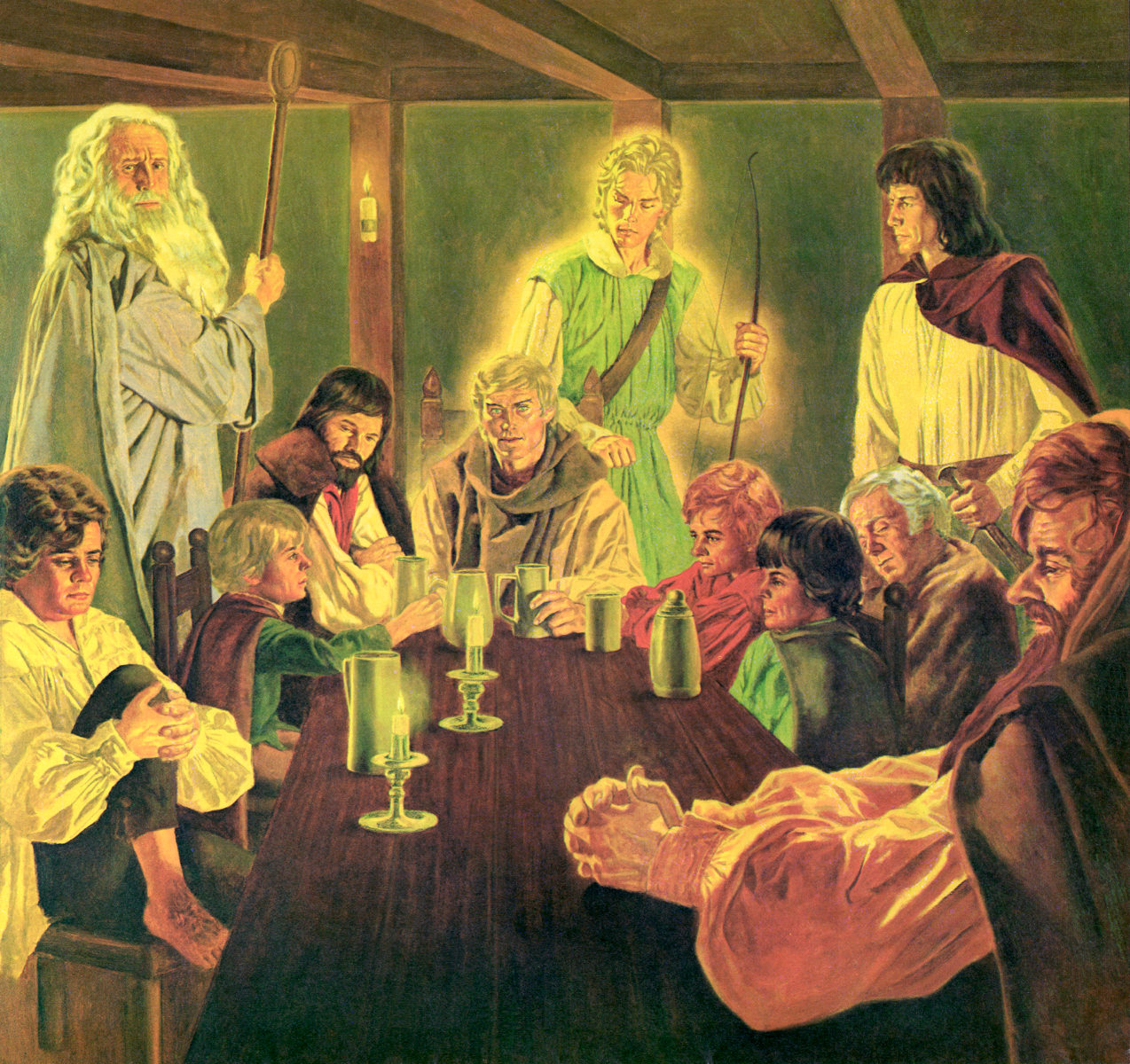
Galadriel's Gifts
In "Farewell to Lorien", the most significant event is the ceremonial departure from the land where Galadriel bestows upon the Fellowship great boons and treasures to help them accomplish their remaining quest. I'm going through these gifts chronologically, with the exception of Aragorn who receives the greatest gift of all.
- Lembas: Elvish bread that is densely packed with nutrition and sustenance and can keep indefinitely. This is a special gift that the Elves had never previously given out to non-Elves.
- Cloaks of the Galadrim: Elvish cloaks that excel in keeping the wearer a consistent temperature (warms and cools them) as well as "magical" properties to seemingly shift colors to hide the wearer. Pippin asks the Elves if these are magical cloaks and the Elves seem puzzled, confused by what Pippen means by "magic"
"I do not know what you mean by that. They are fair garments...lead and branch, water and stone; they have the hue and beauty of all these things under the twilight of Lorien that we love; for we put the thought of all that we kive into all that we make...You are indeed in the favour of the Lady! For she and her maidens wove this stuff; and never before have we clad strangers ub he garb of our own people."
For how ancient Lorien is, I'd say that's a hell of a giftBoromir
- A belt of gold
Merry and Pippin
- Small silver belts, each with a clasp looking like a golden flower
Legolas
- A bow that the Galadrim use which is stronger than the bows Legolas had previously used from Mirkwood.
 |
| Legolas Draws the Bow of Galadriel by Michael Kaluta |
- A small box of earth from Lorien blessed by Lady Galadriel
Gimli
- Three strands of Galadriel's hair
- Galadriel does not have a gift prepared for Gimli and instead asks Gimli "what gift would a Dwarf ask of the Elves".
- Gimli asks no gift of the Elves stating that is enough to have seen the Lady Galadriel herself. I don't think this is him being modest or overly respectful as it is Gimli being humbled by everything he has seen in Lorien and being too proud/stubborn to ask even more of the Galadrim.
- Gimli does respond, and as an expert diplomat too:
"There is nothing, Lady Galadriel, nothing, unless it might be - unless it is permitted to ask, nay, to name a single strand of your hair, which surpasses the gold of the earth as the stars surpass the gems of the mine. I do not ask for such a gift. But you commanded me to name my desire."This is extraordinarily significant. Not necessarily to the story itself but it deepens the world. Galadriel's hair is said to reflect the light of the Trees of Valinor and Feanor, the greatest of the Elven kings and the most advanced craftsmen the world had ever seen (he created the Silmarils) requested a strand of her hair three separate times and was rejected. Feanor later becomes enraged over the Silmarils and is essentially an "Elvish Original Sin" figure and this interaction hints that Galadriel has a gift of insight that is hers alone. By giving Gimli THREE strands, I think she is acknowledging the other request she had for her hair and is deeming Gimli, a fellow craftsmen, to be more pure of heart and worthy of the gift than the self-serving King Feanor. Cool stuff!
Frodo
- Phial with the light of Earendil's star that is caught in water from Galadriel's fountain
- "Earendil's star" is a misnomer because Earendil's "star" is actually a Silmaril. Earendil fastened a Silmaril to his brow and sailed his ship into the sky (this is Tolkien so that's not legend, that happened in the First Age). This light is therefore the light of the Silmarils which themselves captured the light of the Trees of Valinor, the source of illumination and wonder for the entire world before the Sun and Moon were created. This is the most pure and perfect light left in the world and glows all the brighter when darkness sets in.
- The most esoteric and "magical" of the gifts bestowed on the Fellowship, the phial is second in significance only to Aragorn's gift.
- "Magical" sheath for Anduril
- The first gift for Aragorn is a sheath that is beautifully decorated with silver and gold leaves and flowers. Gemstones shaped like Elven runes name the sword Anduril and cite the lineage of the sword. In addition to the stunning beauty, the sheath is said to protect the blade from being stained or broken even in defeat.
- The Elfstone
- Galadriel asks Aragorn if she can present him with any other gift and he answers that all he desires, she cannot give him (clearly, Arwen), and Galadriel has a bit of a surprise for Aragorn.
- While she can't give Arwen herself to Aragorn, she does have a token of hers to give him: a great stone of clear green set in a silver brooch shaped like a great eagle with spread wings
"This stone I gave to Celebrian my daughter and she to hers [Arwen]; and now it comes to you as a token of hope. In this hour take the name that was foretold for you, Elessar, the Elfstone of the house of Elendil!"
 |
| A Farewell to Lorien by Ted Nasmith |
The Transformation of Gimli
As mentioned previously, Gimli desires only a strand of Galadriel's golden hair as a treasure "in memory of your words to me at our first meeting. And if I ever return to the smithies of my home, it shall be set in imperishable crystal to be an heirloom of my house and a pledge of goodwill between Mountain and Wood until the end of days."These are BIG WORDS coming from a dwarf when there has been nothing but animosity between the two peoples for centuries, even millenniums. Let's take a look at Gimli's time in Lorien and deconstruct this change in view.
\
Arrival in the Forest
Gimli is treated poorly by the Elves at the border. Haldir says they have not had friendly deadlings with the Dwarves since the "Dark Days" and that only with Legolas and Aragorn guarding Gimli will he be allowed to pass and even then, he must be blind-folded. Gimli obviously takes a dim view of this arrangement and refuses to go along with the plan. Aragorn arranges for everyone to be blind-folded making it more fair. Gimli accepts this despite Legolas' grumblings. Not a promising start.
Arrival in Caras Galdon
The party arrives to meet the Lord and Lady of the city and are immediately questioned about Gandalf and his "demise". When they relay the tale of the Balrog being found, Celeborn is full of rage, placing it upon Gimli as the representative of the folk who woke the Balrog.
"But had I known the Dwarves had stirred up this evil in Moria again, I would have forbidden you to pass our northern borders. You and all who go with you."
Galadriel is quick to step in, chastising her husband, and defending the Dwarves.
"Do not repent of your welcome to the Dwarf. If our folk had been exiled long and far from Lothlorien, who of the Galadrim, even Celeborn the Wise, would pass nigh and not wish to look upon their ancient home, though it had become the abode of dragons?
Dark is the water of the Kheled-zaram, and cold are the springs of Kibil-nala, and fair were the many pillared halls of Khazad-dum in Elder Days before the fall of mighty kings beneath the stone."Galadriel, in two quick lines, explains the plight of the Dwarves in a way that clearly no other race had thought of before, and also references the glory and splendor of the lost kingdom IN THE NATIVE TONGUE OF THE DWARVES. Not even Gandalf used this language to describe Moria.
Gimli is stunned a bit at first and Tolkien writes, "that it seemed to him that he looked suddenly into the heart of an enemy and saw there love and understanding." Gimli follows this realization by claiming,
"Yet more fair is the living land of Lorien and the Lady Galadriel is above all the jewels that lie beneath the Earth."
In the span of a quick conversation, Gimli's heart and entire worldview of the Elves has changed. He knows that they can have compassion and understanding for the plight of the Dwarves and this change of heart and acceptance of friendship profoundly shapes the rest of the Ring-Quest and Gimli's entire life.
The Transformation of Aragorn
I think three key factors are at play here
- The loss of Gandalf
- The blessing of Galadriel
- Coming closer to the historic sites of Numenorean power
The Loss of the Gandalf
Undoubtedly, Gandalf's loss in Moria is a tremendous blow to the Fellowship. Their emotional, intellectual, and strategic leader suddenly disappears and Aragorn, whether he is ready or not, needs to assume the mantle of leadership.
Aragorn is already a very experienced traveler and warrior, fighting in campaigns across Middle-Earth for all manner of factions (Rohan, Gondor, the Rangers, Rivendell, etc) but this is his most important command yet due to his duties as a member of the Fellowship and as the last living heir of Isildur. With Gandalf in the Fellowship, he could focus on being the heir of Isildur and protecting Frodo without the weight of decision-making. While he would consult with Gandalf, it was clear that Gandalf's opinion held primacy most of the time and Aragorn was glad to have those opinions.
After leaving Moria, I think the party was a bit shell-shocked and Aragorn was reacting on instinct more than anything: get away from the mountain and towards Lothlorien where friends are waiting. Only through spending time in Lorien in safety can his thoughts truly settle and adapt to his new role.
The Blessing of Galadriel
I referenced Aragorn's gift above, where Galadriel literally bids him to do away with his previous monikers and titles and embrace his status as heir to the throne. Her gift, which is really Arwen's gift, signifies a unity between Men and Elves (which as I've written about previously, are very rare and incredibly important) and harkens back to a previous time when the Elves and the House of Elendil still had great might and grandeur.
"Then Aragorn took the stone and pinned the brooch upon his breast, and those who saw him wondered; for they had not marked before how tall and kingly he stood, and it seemed to them that many years of toil had fallen from his shoulders."Aragorn's own spirits are being lifted by the blessing of the most powerful Elf in the world (and grandmother to his own beloved) and this rejuvenation and renewed determination is clearly apparent to the rest of the company.
Nearing the Lands of Numenor
After the party leaves Lorien, they travel down the Great River towards Gondor and Mordor. After several days of travel (including an ambush by orcs which included Legolas shooting down a Fell Beast in the night...) they reach the mighty gates of the Argonath.
The Argonath is probably in my top 3 favorite locations in Middle-Earth. This is place in the river where the Numenoreans built titanic statues unweathered from the centuries of wear and tear. The twin colossuses are of Anarion and Isildur, the sons of Elendil and the Kings of Gondor and Arnor respectively.
When the Great River passes between the statues, the sheer might and power of the location cowers most of the Fellowship. Frodo can't bear to look up and even Boromir keeps his head bowed. Only Aragorn seems to revel in the power of this location.
"'Fear not!' said a strange voice behind him. Frodo turned and saw Strider, and yet not Strider, for the weather-worn Ranger was no longer there. In the stern sat Aragorn son of Arathorn, proud and erect, guiding the boat with skillful strokes, his hood was cast back, and his dark hair was blowing in the wind, a light was in his eyes: a king returning from exile to his own land.
'Fear not!' he said. 'Long have I desired to look upon the likenesses of Isildur and Anarion, my sires of old. Under their shadow Elessar, the Elfstone son of Arathorn of the House of Valandil, Isildur's son, heir of Elendir, has naught to dread!'"That's a heck of a passage and really a marked contrast to the more cautious Strider seen earlier in the book.
 |
| The Argonath by Ted Nasmith |
Conclusion
I think the transition from Moria to Lorien to the wilderness beyond is crucial in understanding several characters and their development. I also could have touched on Boromir whose mania deepens as the chapters progress or Merry who becomes more eager to contribute to the Fellowship or Sam who becomes more resolute the farther he gets from home.I think I'd like to dedicate a whole post to Boromir and his descent into madness when he dies in the third book (first part of the Two Towers) and I'll break it down further.
Hope you enjoyed this marathon of a post, I really enjoyed reading about the transformations of Gimli and Aragorn and thinking what they mean in the larger context.