Showing posts with label First Age. Show all posts

Tuesday, August 20, 2013

Cool sword, bro - Legendary Swords in Middle-Earth's Troll Dens

Departing from our romp toward Moria, I wanted to visit one of my favorite lore tidbits.

In "The Hobbit" Bilbo and friends stumble upon a cache of weapons in the depths of a troll cave in the Trollshaws near Rivendell. These weapons are revealed to be of a superior make, with Gandalf himself taking a longsword as his weapon. Bilbo claims one of the blades as a "finder's fee" of sorts, and fearless leader Thorin Oakenshield gets the other.

"The Hobbit" emphasizes the importance of these weapons and their unique status in Middle-Earth, but it does not explain this importance. These weapons, Sting and Glamdring in particular, also play a huge part of the "Lord of the Rings" but are not expanded upon.

It's not until we start diving into the depths of Tolkien's unfinished notes and short stories that we see a broader picture.

In "The Hobbit", it's clear that the Orcs of the Misty Mountains know these weapons. They curse the blades, calling Glamdring "Beater" and Orcrist "Biter". These swords are remarkable enough to have their own place in the lore of the Orcs of the Misty Mountains but all Tolkien offers is their original names and that they originated in Gondolin during the First Age.

Gondolin. A nice place.


The Fall of Gondolin is one of the most well-known stories in "The Silmarillion" and other Unfinished Tales, and the swords play an important part of that story. Essentially, Gondolin was a hidden city of the Elves, one of the last free kingdoms in Beleriand and Morgoth had spent centuries trying to find and destroy it. Eventually, a traitor revealed the location and the hosts of Morgoth piled on the city and ransacked it. Interesting to note: Glorfindel was at Gondolin when it fell and died defending the fleeing population by slaying a balrog in single combat. The Valar loved this action so much, they sent him back to Middle-Earth.
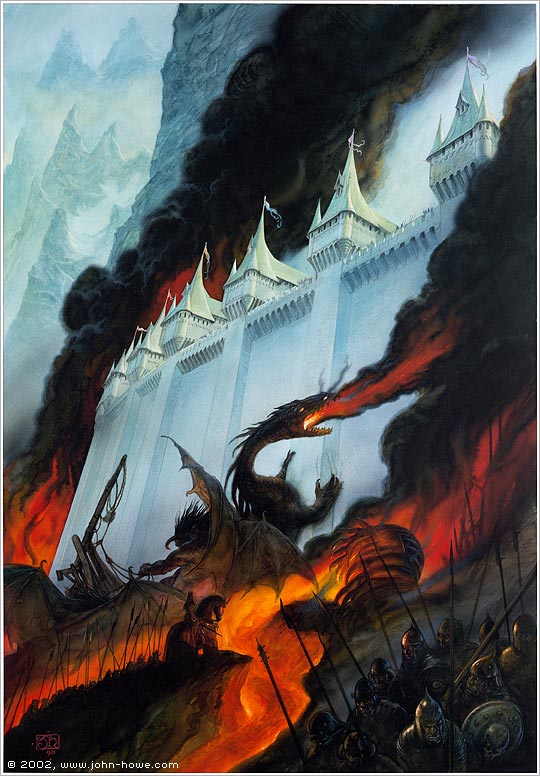
Gondolin. No longer a nice place.


Glamdring's description matches that given to the sword of Turgon, King of the Elves of Gondolin, and although Tolkien never explicitly calls it out, it's pretty fair to say they are the same blade if the Orcs hold reverence and fear for the same blade after 6,500 years.

Ecthelion wields Orcrist against Gothmog.


Orcrist was the sword of Ecthelion, Captain of the Guard of Gondolin and one of the Elves who made the last stand in the center of the city to hold off the Balrogs and orcs from the fleeing civilians. Ecthelion fought Gothmog, the most powerful and leader of the Balrogs, in single combat, and died as he slew Gothmog in the royal fountain at the center of the city. 

From Royalty to Troll Lair


So Ecthelion and Turgon died and their swords were plundered by the victorious orcs. How did they get from Gondolin to the Trollshaws which is FAR away in the East?

I don't know.

Here is my conjecture which you are free to disagree with or add to as desired:

The weapons were taken into the East by the orcs as they migrated after Morgoth was defeated. They likely settled in the Grey Mountains (the mountain range just north of the Misty Mountains) or in the Misty Mountains themselves. Over the years, they warred greatly with the dwarves in these areas and eventually the Dwarves seized these weapons and used them against the orcs, rekindling the old names "Biter" and "Beater" as something to be feared.

Over time these weapons were passed down from father to son (likely from King to the new King and so forth - these are fantastic weapons after all) and after many centuries, a small group of dwarves, including perhaps a Prince or other nobility, were overtaken by trolls in Trollshaws and their cache hidden within the cave.

Conversely, the Dwarves had become surrounded by an orc party and they buried their own weapons knowing how important their weapons were to their people and not wanting them to fall back into Orc hands.

I like these options because men, dwarves, elves, or orcs who would've come across these weapons would be able to tell their quality even without knowledge of history. A longsword is not a common find, much less a finely jeweled one.

Therefore, it's reasonable to assume that whoever placed the blades there did so on purpose, or was oblivious to any value in the weapons.

To Slay a Balrog

It's also noteworthy that two of the three blades found in the Troll's cache are responsible for slaying two of the most famous Balrogs in the history of Middle-Earth.

Ecthelion, who wielded Orcrist, faced Gothmog, the most fearsome of all Morgoth's Balrogs during the Fall of Gondolin. Ecthelion was succesful and Gothmog was slain, although he himself perished in the process, losing Orcrist.

Turgon, King of Gondolin, wielded Glamdring during the battle but subsequently lost it. However, it is on Gandalf's hip that this weapon really impacts the story. Deep within Moria, as we'll see in a coming blog post, the Balrog Durin's Bane appears before the party to drive them out and destroy them. Gandalf defies him and they battle for days, eventually resulting in Gandalf slaying Durin's Bane.

Now, we don't know if Gandalf stabbed Durin's Bane or if he resorted to a Word of Command (Balrogs were once Maiar like Gandalf/Saruman/Sauron as well...) but the important thing is that Glamdring certainly played some part in the battle.

Conclusion

I don't think Tolkien really intended too much by these coincidences since The Hobbit was one of the earliest writings and it was NOT originally intended to be part of the same world as Lord of the Rings. 

Despite that, I think it is a lot of fun and fascinating to think about how these three swords go from the hands of mighty Elven warriors during the First Age to a dirty troll pit 6,500 years later. The additional connection of the two swords responsible for the deaths of the two most famous Balrogs is just icing on the cake.

Intentional or not, I clearly enjoy talking and writing about it.

What's your thought on how the swords got into the troll pit?

Thursday, July 11, 2013

Book 2 Chapter 1: Many Meetings

My brief pause in writing came at a perfect moment in the story. Frodo has just collapsed on the banks of the Bruinen and witnessed the Nazgul being swept away. After this moment, he is rescued by the folk of Rivendell and Elrond begins healing him. It's quite some time, many days, later that he finally wakes up so pretend that my gap in posts is due to staying in character. :)

A Note on Terminology

This is the first chapter of Book Two! It is important to point out that Tolkien did NOT write a trilogy. He wrote one narrative with six constituent books. For example, Books 1 and 2 are typically split into the subheading of "Fellowship of the Ring". Therefore, it is most accurate to read Tolkien in one large volume where it is easier to physically feel the sense of progression throughout the story. The breaking of the Fellowship is not the end of its own novel, it's a dramatic point (one of many) on the slopes of the storyline.

It's a minor distinction but I feel an important one.

Now, onto the chapter itself!

"Many Meetings" along with the following "Council of Elrond" are two of the most lore-dense, plot filled chapters in all of Lord of the Rings and can be a challenge to slog through after several chapters of Cat-and-Mouse through the Lone Lands and the Trollshaws. However, these chapters really allow Tolkien to shine in what he does best, tell a story and make it seem like we're only scratching the surface of his world.

The chapter opens with Frodo waking up to Gandalf (who he hasn't seen in a long, long time) who promptly explains why he was delayed. He also comments on Frodo's EXCEPTIONAL strength. He bore the wound from the Morgul blade for a full 17 days without succombing to the darkness. Gandalf insinuates that most anyone else would have faltered long before which is a great foreshadowing of Frodo's ability to weather the Ring's increasingly powerful effects without being too controlled by it.

The Fair Valley of Rivendell by Ted Nasmith

Lords of the Eldar

Frodo finds himself in Rivendell, home to Elrond, among others, which is famed as being a haven of the "elf-wise, Lords of the Eldar from beyond the farthest sea". These powerful lords of the Elves are beings who once lived in Valinor (the Undying Lands) in the First Age and then came back to Middle Earth. Tolkien writes that these beings "live in both worlds and have great power against the seen and unseen."

Do you remember in the last chapter, Frodo describing a bright light across the river before he blacks out? He is falling under the sway of the Shadow, much like he does when he puts on the Ring and passes into the Unseen World. In this Unseen World, he catches a bright light that shines across the water and then the chapter ends without much further explanation. This light was Glorfindel who, as we've previously discussed, is certainly a capable threat against the Seen and Unseen.

But just who are the other "Lord of the Eldar from beyond the farthest sea"?

Glorfindel told Aragorn in the previous chapter that “few, even in Rivendell, ride openly against the Nine; but such as there were, Elrond sent out north, west, and south.” So clearly, Glorfindel is one of these Elves and rode West to find them. But who were the other two?

I have two theories on this:


  1. Elladan and Elrohir - Elrond's two sons are logical choices since they are very well-esteemed among Elves (Legolas praises them heavily throughout the tale) and are old friends of Aragorn's. However, it is unlikely that Glorfindel would describe the two as capable of riding openly against the Nine, especially since they have not been to Valinor and would not have the same might as someone who has seen Aman.
  2. Two of Elrond's Advisors - Elrond has numerous advisors in Rivendell and Tolkien would not have introduced all of them to us. Think of it this way; if you were telling the story of World War II in the South Pacific, you wouldn't necessarily name Winston Churchill even if was undoubtedly important and played an important role. I think it is very feasible that some of Elrond's advisors were born in Aman and then came over to Middle-Earth. This would place them mighty among the Elves and give them power to ride openly against the Nine.
Your thoughts?

Glorfindel, Elrond, and Earnur go to war.


Powers of the Eldar

But glowing in the Unseen World is not the only power these Lords of the Eldar command. Despite not being born in Valinor, Elrond himself possesses a magic unlike anything else we've seen, or will see. Gandalf reveals that Elrond commanded the flood of the Bruinen and the river is under his control. Gandalf also shares that only Elrond had the power needed to bring Frodo back from the grievous wound he received.

I think this is a very important section and one that really fleshes out some key themes for Tolkien. Elrond is not a divine being. In fact, he is half-Elven; a cross between his Elven mother and Human father. Despite this, Elrond has powers that Gandalf, an immortal being created, not born, cannot match.

Similarly, in the First Age, Feanor created the Silmarils: three brilliant jewels that contained the beauty and light of the world before evil corrupted it. These jewels were perfect, unable to be destroyed, even by the Valar, and not even the mightiest craftsmen of the Valar could match Feanor's skill at crafting.

Also as I discussed in the Glorfindel post, there are examples of Elves fighting Balrogs and Dragons one on one. Balrogs are generally regarded as being the same type of being as Gandalf, mid level immortals who defected to Morgoth.

Time after time, we have the Children of Iluvatar, those that are not truly immortal standing up to the great powers of the world, and besting them in unexpected ways! Tolkien is lauding the capacity of Men and Elves to succeed. In them lies tremendous greatness that can exceed even the brilliance of the Gods, but it is not for everyone and it is not without sacrifice of one's own.

What do you think Tolkien is saying here? Do you find this important or intentional?

The Fellowship Begins to Form

Outside of a discussion on Tolkien's intent, a few plot points happen in this chapter and are important to note. I'm going to throw out a bullet point list with brief comments on a few areas because this post is already long.

  • Sam hardly left Frodo's side during the days he was at Rivendell. Remember that these two WERE NOT EVEN FRIENDS before this trip began. Merry and Pippen were not always present and they had been Frodo's best friends. Does this say more about Sam or Merry/Pippen? I think it says more about Sam's character.
  • Frodo meets Gloin who came to Rivendell with his son Gimli. Gloin, you'll remember, is one of the 12 Dwarves that went with Bilbo to the Lonely Mountain. They talk briefly but neither really knows why everyone has been summoned. Gloin shrugs it off and says that "Master Elrond" will sort it out. When has a Dwarf been this respectful of an Elf? Is the line out of character or does Elrond command such respect among other races?
  • Bilbo is alive and well! He is living in Rivendell with the Elves who treat him with the highest level of respect. At feasts, Elrond treats Bilbo as an old friend, sharing food and wine personally. Bilbo and Aragorn have also been acquainted for years and Aragorn often helps him write and sing new songs and tunes. This helps explain why Aragorn was unsurprised when Frodo said Bilbo had translated some of the Ballad of Beren and Luthien before the party had reached Weathertop.
  • Aragorn himself is accorded a great deal of respect. He grew up in Rivendell and is referred to as The Dunadan. Dunadan means "Man of the West", but with "The" as a prefix, it implies that he is the most important one. 
Frodo has found himself with some pretty dang important people doing things at a higher level than he can really understand right now. Glorfindel alone has lived longer than just about everyone introduced to the story so far (excepting a few notable ones) combined and Aragorn's mysterious shroud is being slowly revealed, piece by piece, often leaving more questions than answers in the wake.

Next up is the Council of Elrond. The longest chapter in the history of literature (that was hyperbole) and also the most dense (also hyperbole). Disregarding the hyperbole, there is a lot to dissect and I'll likely grab two blog posts to do it.